Medical Research Institute KITANO HOSPITAL, PIIF Tazuke-Kofukai
Inquiry
search
close


Departments
We are currently receiving a large number of inquiries, so we have temporarily stopped accepting new inquiries.
We will announce this on our website again when we resume accepting applications.
We apologize for any inconvenience this may cause to those who are considering using our services, and we appreciate your understanding.
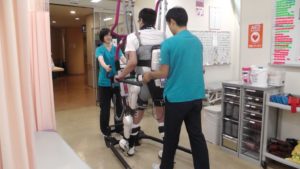
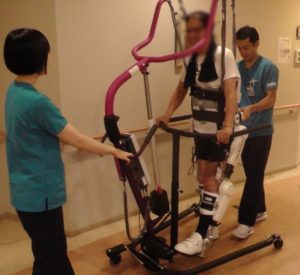
In our rehabilitation department, we use the cyborg robot HAL.®(Hybrid Assistive Lumb®) We have started outpatient rehabilitation using medical lower limb types.
HAL®HAL is a device worn on the body to assist the wearer in physical movement. When the wearer tries to move their body, signals are transmitted from the brain to the muscles. At this time, weak BES (bioelectric signals) appear on the skin surface.®The device assists lower limb movements using information obtained from various sensors built into the device and through electrodes attached to the skin surface.
For more details, please see below.
CYBERDYNE, Inc.(Cyberdyne, Inc.)
By undergoing walking training using the cyborg robotic suit HAL®, some people have noticed improvements not only in their walking function, such as "increased walking distance" and "increased walking speed," but also in their overall daily living function, such as "it has become easier to stand up from a chair."
Some people may think that it will become difficult to exercise as muscle strength and endurance decline, but it is possible to train appropriately under the guidance of a physical therapist.
If you are interested, please feel free to contact us.
Rehabilitation Department, Dr. Odo
HAL®The medical lower limb type is intended to improve standing and walking difficulties in patients with intractable neurological diseases. Currently, the only slowly progressive neuromuscular diseases covered by health insurance are those diagnosed with the following eight diseases and are limited to those who hold a certificate for specified medical expenses (specified intractable diseases).
| Eight target diseases | |
|---|---|
| Spinal muscular atrophy | Distal myopathy |
| Spinal and bulbar muscular atrophy | Inclusion body myositis |
| Amyotrophic lateral sclerosis | Congenital myopathy |
| Charcot-Marie-Tooth disease | muscular dystrophy |
In addition to the eight diseases listed above, the following two diseases will also be covered from November 10, 2023.
| HTLV-1-associated myelitis | Hereditary spastic paraplegia |
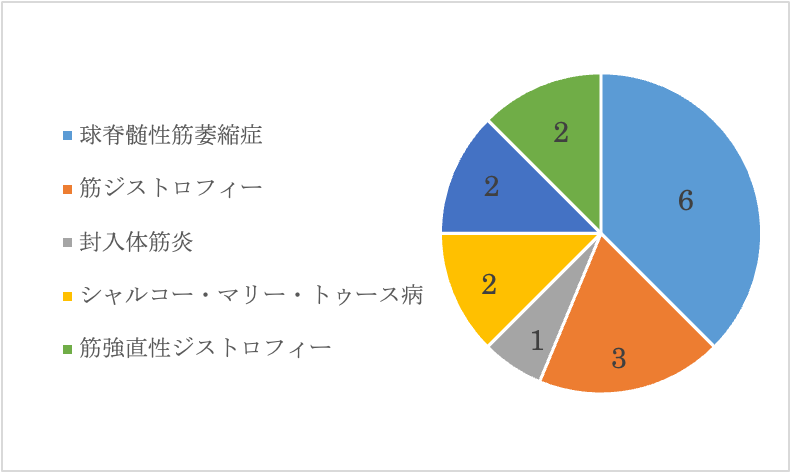
Breakdown of implementation from January 2023 to December 2023
| Target Audience | 16 (including 7 new patients) | |
|---|---|---|
| By disease | Spinal and bulbar muscular atrophy | 6 people |
| muscular dystrophy | 3 people | |
| Inclusion body myositis | 1 person | |
| Charcot-Marie-Tooth disease | 2 people | |
| Spinal muscular atrophy | 2 people | |
| Myotonic dystrophy | 2 people | |
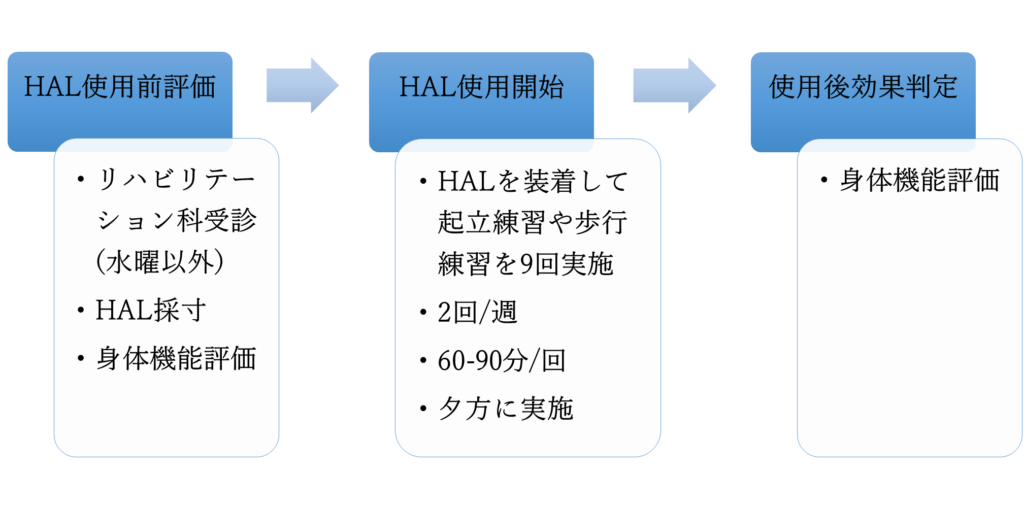
Those who wish to use it will need to be examined by a rehabilitation doctor.When visiting the clinic, you will need a referral letter from your family doctor.It will be.
For inquiries, please contact Kitano Hospital Rehabilitation Department Please contact us.
Phone number: 06-6312-8844
After using HAL, I was able to walk for long distances and take up stairs in my daily life.
I was able to do this without getting tired, which was more than I expected. I think the fact that I can move around so much without getting tired is due to the effect of HAL.
I want to continue this so that I can feel more changes in my body.
When I first started HAL, I felt very tired, but as the number of times I did it increased, I started to feel less tired. Until now, my legs would get stuck and it was often difficult to put my legs out, but now I'm gradually getting the feeling to swing my legs out.
Since starting HAL, my child has become more motivated to walk. Compared to how he used to walk, he has remembered the timing of his steps. I feel like I can walk like before.
Since starting HAL, it has become easier to stand up. My knees have bent less when I walk. It has become easier to walk, and I have started walking in my daily life. However, HAL® fatigue tends to be delayed.
Please contact the Rehabilitation Department.
Phone number: 06-6312-8844
Including the pre- and post-treatment evaluations, one course requires 11 visits to the hospital.®The number of times to use is 9 times per course.
HAL®To achieve the desired effect, it is said that it needs to be done at least twice a week.
Each session is expected to last approximately 60-90 minutes.
HAL®While wearing the device, you will mainly practice standing and walking.
It may feel awkward until you get used to it, but our staff will help you set it up to suit your needs as quickly as possible.
HAL®There is no guarantee that patients will be able to walk again, but many patients have noticed a change in their gait.
Please wear comfortable clothing and a tracksuit as your bottom layer.
Please refrain from wearing patches, stockings, tights, etc. as electrodes will be attached to the buttocks, thighs, and around the knees.
HAL®If improvement is observed after use, you can continue using the treatment.
It is possible. HAL®To undergo this treatment, you will need a referral letter from your family doctor addressed to our rehabilitation department.


