Medical Research Institute KITANO HOSPITAL, PIIF Tazuke-Kofukai
Inquiry
search
close


Departments
We have opened the "Pectus Excavatum Center," which can provide comprehensive diagnosis and treatment for pectus excavatum. Pectus excavatum is a congenital disorder, but many people, both children and adults, suffer from it. We examine those who have been diagnosed with pectus excavatum during a medical examination or who are troubled by a hollow in their chest, including determining whether treatment is necessary. Please feel free to consult us.
Our hospital has a thoracic surgery department that specializes in chest surgery, an orthopedic surgery department that specializes in bones, an anesthesiology department that specializes in anesthesia and pain management, a plastic surgery department that specializes in scars, and a rehabilitation center that specializes in respiratory rehabilitation.Since many of our target patients are children, our center has a pediatric surgeon with extensive experience in treating pectus excavatum who acts as the liaison for consultations and treatment.
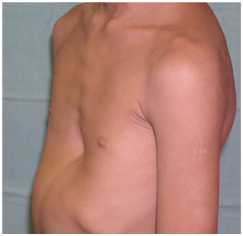
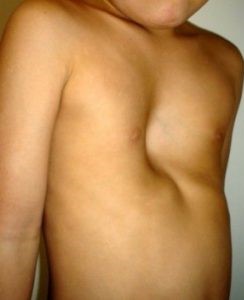
A deformity in which the center of the chest is concave is called "pectus excavatum." It is thought to be caused by a deformation of the costal cartilage, but there are many unknown aspects of this condition. It can be noticed in infants or young children, or it may become more noticeable as they grow older, but it is said to occur in about 1 in 1,000 people, so it is not a rare condition. Depending on the degree of the concavity, cold symptoms may linger or asthma-like symptoms may appear, but in most cases there are no symptoms other than the concavity. Even without physical symptoms, the concavity itself can become a significant psychological and social problem, especially during childhood and adolescence.
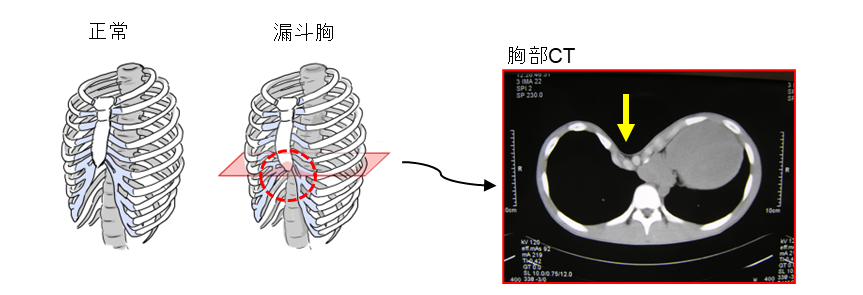
Treatment options at our center include surgical and non-surgical options.
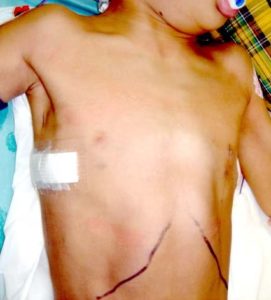
Surgical treatment involves thoracoscopic-assisted sternal elevation, also known as the Nuss procedure, a minimally invasive surgical technique reported by Dr. Nuss in the United States in 1998. Through 3-4 cm incisions in the skin of both chests (under the armpits), a metal bar is implanted in the chest to lift the anterior chest from the inside, correcting the depression. Unlike conventional methods, it does not involve cutting the ribs or sternum, resulting in shorter surgery times, less bleeding, and less noticeable scarring. The metal bar is removed after 1.5 to 3 years, depending on age.
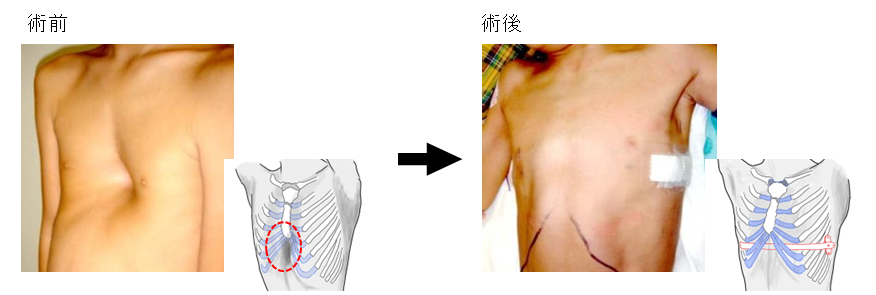
The surgery will be performed under general anesthesia. Because this surgery corrects the bones, you will experience significant pain after the procedure. To alleviate this pain, we will use epidural anesthesia (an anesthetic in which a thin tube is inserted between the vertebrae and pain medication is continuously administered).
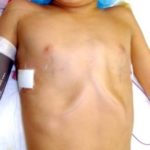
Each case shows the condition before and immediately after surgery.
 →
→ 
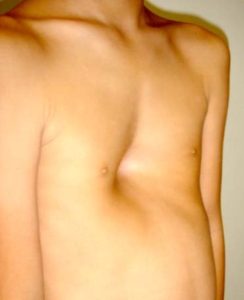 →
→ 
Exercises that open up the chest, such as swimming, increase lung capacity and improve the shape of the chest. While they are somewhat effective, they do not significantly improve the hollowness of the chest itself. Another problem is that people with pectus excavatum often dislike swimming.
Many patients with pectus excavatum have a hunched back, which makes the depression in their chest even more noticeable. If you stick out your chest and take deep breaths, the depression will become less noticeable. Also, making an effort to stick out your chest before and after surgery will improve your posture and prevent the bar from slipping.
This method involves attaching large suction cups to the anterior chest wall and applying negative pressure to lift the chest wall. It does not require surgery, but it needs to be performed for several hours daily. While it cannot be expected to be more effective than surgery, it has been shown to be effective for mild cases of chest depression. Since it is performed daily, the purchase of equipment is necessary.
It is best to perform surgery at an age when the costal cartilage is still soft, but we ask that you avoid surgery at an age where the patient will not be able to remain still after surgery and will not cooperate. Also, if surgery is performed too early, the depression may progress again. Therefore, we believe that surgery is best performed after the fourth grade of elementary school.
On the other hand, once a student reaches high school age or older, their ribs and cartilage become hard, so they may need to insert two or more metal bars or make small cuts in their ribs to create a beautiful chest shape.Our hospital has a wide range of patients, from elementary school students to adults, who undergo surgery.Between 2019 and 2025, we performed surgery on 142 patients. The average age at the time of surgery was 16 years old (ranging from 5 to 42 years old), with 114 males and 28 females. We consult with patients to find a convenient date and time, taking into consideration their school holidays and work schedules.
Our clinic also offers alternative treatments to surgery, such as negative pressure suction therapy (vacuum bell). At our pectus excavatum clinic, we discuss the necessity of treatment based on each patient's condition. Whether you decide to pursue treatment or not, please feel free to consult us if you are concerned about pectus excavatum.
| Clinic date | Wednesday mornings, Thursday afternoons *Excluding national holidays and the New Year holidays |
|---|---|
| Medical reception hours | [Wednesday] 8:45-11:30 [Thursday] 13:30-15:00 |
| How to get examined | You can get a consultation without making an appointment *However, patients who do not have a referral letter from another clinic or hospital at the time of their first consultation will be charged a selected medical fee in addition to the regular initial consultation fee and other medical expenses.What are selected medical expenses?). |
| About reservations | From the patientFor appointment reservations, please see this pagePlease check. |
2nd floor B block reception
Phone 06-6312-8827


