Medical Research Institute KITANO HOSPITAL, PIIF Tazuke-Kofukai
Inquiry
search
close


Departments
For hematological malignancies, chemotherapy and radiation therapy are the primary treatments. Anticancer drugs are chosen based on the most appropriate treatment for each patient's condition. Our department routinely uses 30 to 40 different anticancer drugs, including oral and intravenous medications. While some of these drugs have strong side effects, there are also effective drugs that suppress side effects such as nausea. Based on the latest evidence, which drug combinations are most effective with the fewest side effects, we recommend the best treatment for each patient. Ultimately, the choice of which of these and other treatment options to choose is left to the patient's own discretion.
In addition to anti-cancer drugs, various cutting-edge treatments are available, including differentiation induction therapy, molecular targeted therapy, and missile therapy using monoclonal antibodies, with the aim of achieving a complete cure. We also offer autologous peripheral blood stem cell transplantation, which involves the administration of ultra-high doses of anti-cancer drugs, and allogeneic hematopoietic stem cell transplantation (also known as bone marrow transplantation), which is a type of immunotherapy. During treatment, patients will be required to stay in a clean room when their white blood cell count drops drastically and their resistance is weakened.
The clean room is a hospital room for patients whose white blood cell counts are likely to decrease due to treatment, weakening their resistance. When white blood cell counts decrease, patients are more susceptible to infection by pathogens such as bacteria, fungi (mold), and viruses transmitted through people and the air. Infection can become severe, so preventing infection is extremely important for treating the underlying illness. Clean air that has been filtered to remove bacteria and fungi flows through a machine called an isolator installed in the clean room. As a general rule, patients are not allowed outside the room during treatment in this room, which may cause some inconvenience. However, please understand that a clean environment is essential for safe and effective treatment during the period when resistance is low.
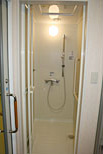
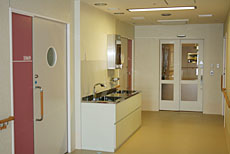
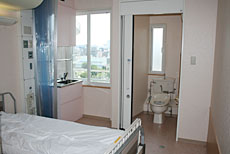
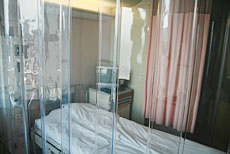
Kitano Hospital has a total of 15 clean rooms, of which 9 are private rooms and the rest are shared rooms with 3 beds each.
*Training facility certified by the Japanese Society of Hematology
Red blood cells, white blood cells, platelets, and lymphocytes are produced by the proliferation, differentiation, and maturation of hematopoietic stem cells in the bone marrow throughout the body. Leukemia occurs when these hematopoietic stem cells become cancerous during the process of developing into various blood cells. If this disease progresses, it can infiltrate organs, cause infections, bleeding, etc., and become fatal. Leukemia can be broadly classified into acute leukemia and chronic leukemia.
Acute myeloid leukemia is divided into acute myeloid leukemia and acute lymphocytic leukemia. Treatment for both myeloid and lymphocytic leukemia begins with intensive chemotherapy (primarily induction therapy using the JALSG-97 protocol) aimed at achieving complete remission (a state in which leukemia cells in the bone marrow are reduced to 5% or less and normal bone marrow function is restored). At our hospital, the remission induction rate for acute myeloid leukemia is approximately 80-901 TP3T. High-risk patients under the age of 50 are actively referred to Kyoto University, Osaka University, Hyogo College of Medicine, Kansai Medical University, and other institutions for allogeneic bone marrow transplantation after achieving remission. Acute promyelocytic leukemia has been successfully treated with differentiation induction therapy using all-trans retinoic acid (ATRA), a vitamin A derivative.
A specific chromosomal translocation, t(9;22), creates the BCR/ABL fusion gene, which causes chronic leukemia. The condition usually remains stable for several years (3-4 years) (chronic phase), after which it progresses to blast crisis and turns into acute leukemia. The first-line treatment is Gleevec, a drug that binds to the ABL protein and suppresses its function. While good therapeutic effects have been achieved, the effectiveness of long-term administration remains unclear. If certain conditions are met, allogeneic bone marrow transplantation is indicated. Other options include interferon therapy and the anticancer drug Hydrea.
This disease causes an increase in lymphocytes in the peripheral blood and bone marrow, resulting in swelling of the lymph nodes throughout the body.
No treatment is required in the early stages, but as the disease progresses, administration of anticancer drugs (such as fludarabine) becomes necessary.
This is a disease in which lymphocytes, a type of white blood cell, become cancerous, causing the lymph nodes to swell and tumors to form in other organs such as the liver and spleen. Diagnosis is made by performing a biopsy of the enlarged lymph node and determining the pathological diagnosis. Tests such as CT scans, bone marrow aspiration, and gallium scintigraphy are then performed to determine the stage of the disease.
Treatment varies depending on the type and stage of lymphoma. For non-Hodgkin's lymphoma, CHOP therapy is primarily used as a multi-drug chemotherapy. Chemotherapy based on collaborative protocols with Kyoto University and other facilities is also administered depending on the patient's condition. In addition, autologous peripheral blood stem cell transplants are performed in high-risk cases. Low-grade B-cell lymphoma and mantle lymphoma are treated with anti-CD20 antibodies alone or in combination with chemotherapy (CHOP therapy, etc.). For Hodgkin's disease, depending on the stage of the disease, radiation therapy alone, chemotherapy (mainly ABVD therapy), or chemotherapy alone is administered. For adult T-cell lymphoma, various multi-drug chemotherapy is selected as the treatment.
Multiple myeloma is a neoplastic proliferation of plasma cells, a type of B cell.
These tumor-like growing myeloma cells produce a single type of protein (monoclonal (M) protein or Bence Jones protein), which increases in the blood and urine. Diagnosis is made by identifying these proteins and detecting an increase in myeloma cells in a bone marrow aspiration test. Myeloma cells also create bone lesions in the spine, ribs, pelvis, skull, etc., which can cause pathological fractures. In the early stages, the disease may be monitored without treatment. Depending on the stage of the disease, chemotherapy such as MP therapy, DMVM-IFN, or VAD therapy is administered. Radiation therapy may also be administered for bone lesions.
Aplastic anemia is a disease characterized by peripheral blood pancytopenia (a decrease in red blood cells, white blood cells, and platelets) and bone marrow hypoplasia. It is believed to develop due to immunological mechanisms coupled with abnormalities in hematopoietic stem cells. Diagnosis requires at least peripheral blood tests, bone marrow aspiration tests, and bone marrow biopsy tests. Treatment varies depending on the severity of the disease. Severe cases may require frequent red blood cell and platelet transfusions. Patients under 45 years of age with severe aplastic anemia who have an HLA-matched sibling donor are candidates for bone marrow transplantation. For severe or moderate cases where bone marrow transplantation is not possible, immunosuppressive therapy is the first choice. Our hospital actively administers antithymocyte globulin (ATG) or cyclosporine.
This is an autoimmune disease in which platelets decrease due to the production of antibodies against one's own platelets. Platelets bound to autoantibodies are captured by reticuloendothelial tissues such as the spleen, leading to their destruction. It is not known why autoantibodies are produced. For this reason, this disease has been designated as an intractable disease by the Ministry of Health, Labour and Welfare. Diagnosis requires that bone marrow megakaryocytes are normal or increased, and that other diseases that cause thrombocytopenia can be ruled out.
Treatment begins when platelet count is below 20,000/μL or 50,000/μL and there is a tendency to bleed, and the first choice is administration of corticosteroids (prednisolone 0.5-1 mg/kg). If corticosteroids are ineffective, splenectomy is indicated. If there is significant thrombocytopenia at the time of surgery or in an emergency, high-dose immunoglobulin administration may be required.
Underlying diseases that can cause lymph node swelling include infectious diseases (viral infections, bacterial infections), malignant tumors (malignant lymphoma, cancer metastasis), autoimmune diseases, etc. At our hospital, we carefully listen to your medical history and accurately understand your overall condition and the characteristics of your lymph nodes before deciding on and carrying out the necessary tests (blood tests, ultrasound, CT scans, and other necessary imaging tests, as well as lymph node biopsies).


