Medical Research Institute KITANO HOSPITAL, PIIF Tazuke-Kofukai
Inquiry
search
close


Departments
| attending physician | Dr. Koji Takeda |
|---|---|
| Outpatient | Thursday Outpatient Clinic |
Human blood vessels include arteries that travel from the heart to the periphery and veins that return from the periphery to the heart.
The veins in the legs return blood to the heart against gravity, thanks to the pumping action of the calf muscles and valves that prevent venous blood from flowing backward.
When these valves are destroyed, venous blood flows backward, causing the veins to expand and become tortuous like lumps (varicose veins).
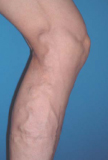
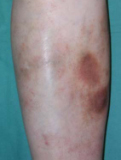
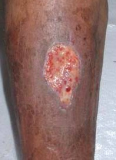
Causes of valve failure include genetics, pregnancy, childbirth, and prolonged standing at work. In the early stages, a soft, bluish lump appears on the inside of the calf, and dirty blood accumulates in the leg, causing swelling, fatigue, and cramps. The patient may feel fatigue in the lower limbs when walking, leading to a desire to rest (intermittent claudication). In severe cases, bleeding may occur from eczema or varicose veins, the skin may harden and turn brown, and skin ulcers may develop. These skin ulcers are extremely painful and do not improve easily even with ointment treatments, so they are called intractable skin ulcers. For those with pigmentation or skin ulcers, surgery is strongly recommended.
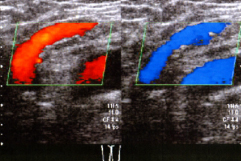
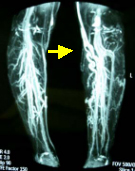
Ultrasound (echo) examinations are used to check whether the venous valves that prevent blood from flowing backward are functioning properly. This test is painless, as it simply involves applying a jelly and placing a probe called a probe. We also check the diameter of the veins and the time of reflux, which are used as indicators for selecting treatment methods. We can also check whether you have had deep vein thrombosis in the past or present. Angiography using tomography may also be performed to understand the overall condition of the blood vessels.
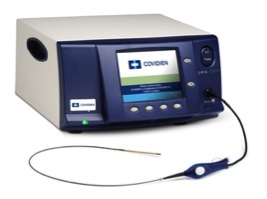
This treatment uses high frequency (radio waves) to cauterize the inside of the great saphenous vein, where blood is flowing backward from the deep veins due to valve insufficiency, to stop the backflow. High frequency waves are irradiated into the blood vessel from the tip of a thin fiber inserted into the blood vessel, causing thermal denaturation of the cells in the blood vessel wall, thereby closing the blood vessel. The entire 7 cm tip of the fiber becomes highly heated, making it superior to conventional intravascular lasers in that it can close the blood vessel wall uniformly. As the only incision is a small opening for inserting the catheter, postoperative pain and subcutaneous bleeding are mild, allowing patients to return to their daily lives quickly.
We are one of the few facilities that perform endoscopic subfascial perforator resection (SEPS) for advanced varicose veins of the lower extremities that are difficult to treat with conventional surgery.
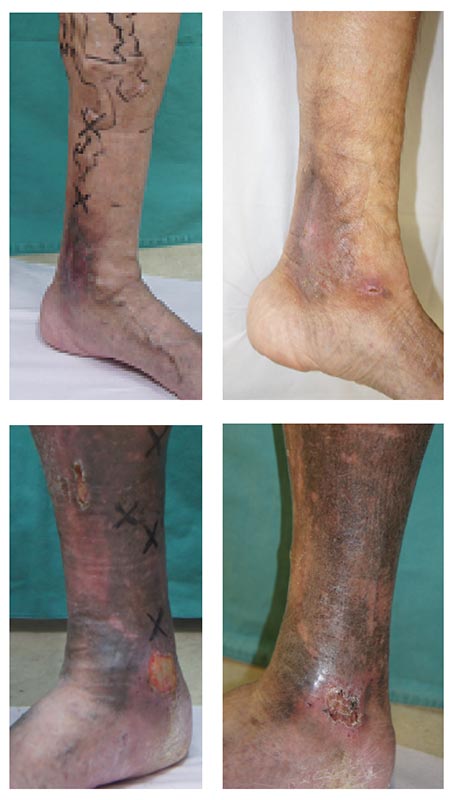
If varicose veins in the lower extremities worsen and cause hardening of the skin, stasis dermatitis, or ulcers, this may be due to insufficient valves in the small veins that connect the deep veins in the affected area of the skin with the superficial veins closer to the skin (the presence of incompetent perforating veins).
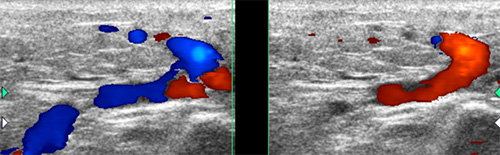
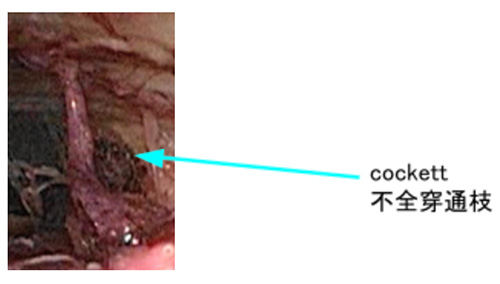
Skin with pigmentation or ulcers is very delicate, and making an incision there can make it difficult to heal. However, with SEPS, an endoscope is inserted into the subfascial layer through healthy skin without making an incision in the affected skin, and the incompetent perforators causing the ulcer are resected, preventing the development of new ulcers and delayed wound healing. Our department uses a two-port SEPS system, which inserts endoscopic ports into two locations in the lower leg.
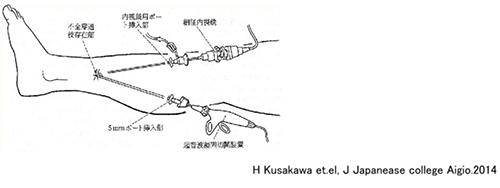
Our department always strives to make the incisions as small as possible, with each incision being just a few millimeters in size, leaving barely noticeable scars. Treatment is mainly performed as an inpatient stay, but depending on the treatment, same-day treatment is also possible.
In order to prevent the formation of new varicose veins, compression therapy using medical elastic stockings specifically for varicose veins is necessary before and after surgery.