Medical Research Institute KITANO HOSPITAL, PIIF Tazuke-Kofukai
Inquiry
search
close


Departments
| attending physician | Doctor Namiko Ishikawa |
|---|---|
| Outpatient | Lymphedema Outpatient Clinic (2nd and 4th Mondays) |
Blood circulating in the body travels through arteries to peripheral tissues, and plasma components leak out of the blood vessels through capillaries, supplying oxygen and nutrients and absorbing waste products. 90% of the leaked plasma components are reabsorbed and returned to the heart through veins.
At this time, 10% (about 2 liters) of the plasma components that leaked out of the blood vessels are absorbed by lymphatic capillaries and become lymph. Lymph enters the circulatory system called the lymphatic system, returns to the heart through lymph nodes, and joins with veins at the venous angle near the shoulder.
Lymphedema is a condition in which lymph fluid accumulates in the limbs, causing swelling, due to obstruction of lymphatic return to the heart. Lymphedema is classified into primary and secondary. Primary lymphedema is thought to develop due to poor formation and decreased function of lymphatic tissue, and the timing of onset varies depending on the severity.
In Japan, secondary lymphedema is primarily caused by surgery for breast cancer or abdominal malignant tumors (uterine cancer, ovarian cancer, etc.) that requires lymph node dissection. Other causes include trauma or surgery on the limbs, radiation therapy, and filariasis (roundworm) infections that occur in tropical regions, and can appear several years after trauma, radiation therapy, or surgery.
Impaired lymphatic return causes lymphatic congestion, making it easy for minor trauma to cause cellulitis, and repeated inflammation leads to fibrosis around the lymphatic tissue, causing irreversible edema and progression. Eventually, the skin hardens, resulting in an elephantiasis-like condition that makes it difficult to bend the knees or walk. For this reason, it is important not to leave the condition untreated and to start treatment early.
At our hospital, doctors and specialized nurses work as a team to treat both primary and secondary lymphedema.
Plastic surgery consultation

Diagnosis of lymphedema by ICG lymphangiography
A dye called indocyanine green (ICG) is injected under the skin and viewed with a special camera to visualize and observe the state of the lymphatic vessels.
Acquire massage techniques and compression therapy (complex physical therapy) under the guidance of nurses
Deciding on surgery after considering the effects of complex physical therapy
It is one of the few hospitals that can provide comprehensive physical therapy and surgery while planning treatment appropriate to the patient's social status and situation.
At our clinic, nurses who are certified medical lymphatic drainage therapists provide lifestyle guidance, skin care, massage, compression therapy, and more.
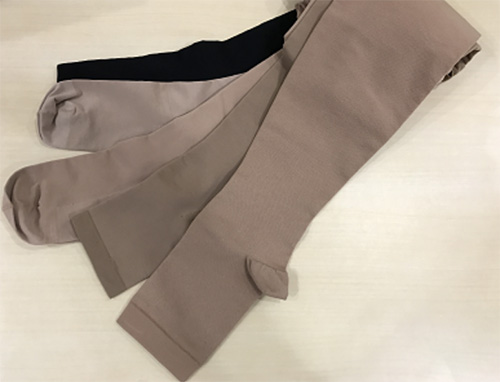
compression stockings
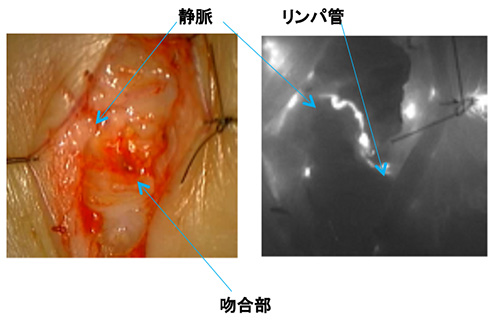
Ultra-microvascular surgery techniques have made it possible to connect tiny blood vessels that were previously impossible, enabling surgical treatments that are less stressful on the body and have excellent therapeutic effects. During surgery, lymphatic vessels and venules are accurately anastomosed using a Carl Zeiss Pentero surgical microscope equipped with an ICG observation device.
This is a video after anastomosis of the lymphatic vessel and vein. We can see under a microscope that lymph is flowing into the vein.