Medical Research Institute KITANO HOSPITAL, PIIF Tazuke-Kofukai
Inquiry
search
close


Departments
| attending physician | Dr. Yoshihisa Suzuki |
|---|---|
| Outpatient | Ptosis Outpatient Clinic (2nd and 4th Thursdays) |
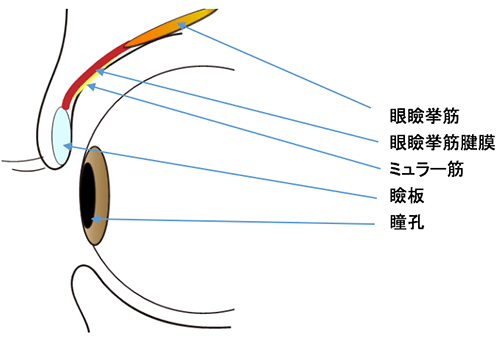
Ptosis is a condition in which the upper eyelid (upper eyelid) does not lift sufficiently when you try to open your eyes, obscuring part of the pupil (black part of the eye). The eyelid is made of a cartilage called the tarsal plate, which supports and protects the eyeball, and is attached to a muscle called the levator palpebrae superioris, which lifts the eyelid. Behind the levator palpebrae superioris runs a thin muscle called the Müller's muscle, which works together with the levator palpebrae superioris to open the eyelid. The levator palpebrae superioris forms a very thin membrane called the levator aponeurosis near the tarsal plate. When the levator palpebrae superioris contracts and pulls up the levator aponeurosis, lifting the eyelid along with the tarsal plate and allowing the eye to open. Ptosis occurs when the levator palpebrae superioris becomes loose or detaches from the tarsal plate, preventing the eyelid from lifting properly.
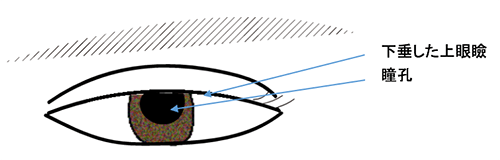
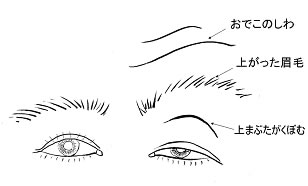
When you have ptosis, you can't lift your eyelids properly, which obscures your pupils and makes it difficult to see. This causes unconscious tension in the forehead muscles, leading to the habit of lifting your eyebrows and lifting your eyelids, which causes wrinkles on the forehead. The skin on your eyelids, between your eyebrows, and at the corners of your eyes also stretches, causing your eyelids to sag and disrupting your double eyelid line. Additionally, the fat in your upper eyelids is pulled back, causing your eyelids to sink. It can also cause headaches and stiff shoulders.
This type of ptosis can be treated with surgery, which can help open your eyes more easily and restore a more youthful appearance to your face.
If there is no impairment to the levator function, we perform surgery to remove the excess skin.If the levator muscle is loose or has come off the tarsal plate and the function of the levator muscle is not being transmitted properly to the tarsal plate, we perform levator shortening surgery or levator advancement surgery to reattach the levator muscle and tarsal plate.The skin incision may be made along the double eyelid line or under the eyebrow.
The procedure varies depending on the degree of levator function and symptoms, and if the levator function of the superior palpebra is severely impaired, a frontalis lift is performed. A frontalis lift is a method of moving the eyelids using the power of the forehead muscle (frontalis muscle). An artificial membrane called Gore-Tex or the quadriceps aponeurosis is often used, but thick thread may also be used.


