heart failure
We will introduce team medical care for heart failure.
The number of patients with heart failure has been increasing recently, and the majority of these patients are elderly.
Problems faced by elderly patients with heart failure include long hospital stays and a high rate of readmission. To address these issues, we are working with various professionals within the hospital and in the local community to try to shorten the length of hospital stays and prevent readmissions.
1) Attempts to reduce hospital stays
When patients are hospitalized for heart failure, they are initially administered oxygen and given intravenous drips, which means they are forced to remain in bed for long periods of time. Even if the heart failure improves, rehabilitation does not progress and hospitalization is prolonged due to the decline in swallowing, cognition, and lower limb muscle function caused by prolonged bed rest.
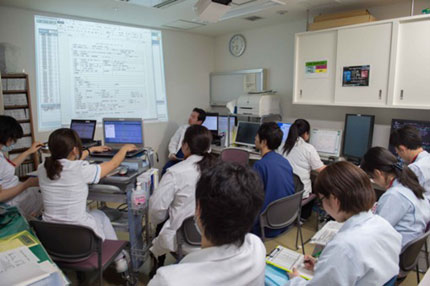
Therefore, at our hospital, we start rehabilitation at the bedside while patients are receiving oxygen and intravenous therapy, so that the decline in each function can be improved as quickly as possible.In addition, because preparing for nursing care support after discharge (application for nursing care certification and classification changes) takes time, we hold a multidisciplinary conference once a week to identify patients who need discharge support, and provide discharge support in parallel with treatment for heart failure from the early stages of hospitalization.
These efforts have reduced the average length of hospital stay from 37.2 days to 19.2 days.
② Attempts to prevent re-hospitalization
Cardiac function deteriorates upon hospitalization, so preventing re-hospitalization is necessary to maintain prognosis and quality of life.
In order to prevent readmission, it is first necessary to adhere to self-management (restricting fluid and salt intake and complying with oral medication).
Also, if heart failure worsens, re-hospitalization can be prevented by visiting the outpatient clinic as soon as possible and having your medication adjusted.
However, determining the right timing for outpatient visits when heart failure worsens is difficult not only for patients and their families but also for visiting nurses. Therefore, our hospital uses a scored self-management form that we developed ourselves to make it as easy as possible for patients to visit the outpatient clinic early when heart failure worsens.
To prevent such readmissions, we hold heart failure classes for patients and their families during their hospitalization, and provide education to patients from multiple professions three times a week, so that they can adhere to self-management and seek outpatient care early if their heart failure worsens.
However, due to the aging of patients and the increase in elderly households (elderly people living alone or with elderly spouses), it is becoming more difficult to comply with self-management and fill out self-management forms.
Therefore, at our hospital, we identify patients who have difficulty managing themselves at multidisciplinary conferences and ask visiting nurses and helpers to intervene, creating an environment where patients can adhere to self-management and seek outpatient care early if their heart failure worsens.