Medical Research Institute KITANO HOSPITAL, PIIF Tazuke-Kofukai
Inquiry
search
close


Departments
Like ischemic heart disease, this is a disease in which arteriosclerosis occurs in peripheral blood vessels, including the arteries of the lower limbs, causing them to narrow or become clogged, preventing sufficient blood flow.
If ischemia occurs in the arteries of the lower limbs, symptoms such as fatigue, lethargy, pain, and cramps appear in the lower limbs, especially the calves, when walking, making it difficult to walk.intermittent lameness) If your feet are cold or have a bad color (purple), you may also be suspicious. As the disease progresses, your feet may start to hurt even when you are standing still.pain at rest).If it gets worse,ulcerFormingnecrosisIn severe cases, the patient may need to have surgery (lower limb amputation).
If a condition is suspected during the medical interview, blood flow will be evaluated using ABI (ankle-brachial index), SPP (skin perfusion pressure), vascular ultrasound, contrast CT, MRI, catheterization, etc.
Treatment options include:Drug treatment,catheter treatment,surgeryThere is.
Our department performs catheter treatments on the arteries of the lower limbs, subclavian arteries, renal arteries, etc. Depending on the location, we can treat those with poor renal function with carbon dioxide gas without using contrast agents.
The iliac artery region has relatively good long-term outcomes. Intravascular ultrasound (IVUS) is used to analyze the lesion in detail, and stents are generally placed.
Depending on the nature and form of the lesion, we perform balloon therapy using a drug-eluting balloon or stent therapy. In February 2016, the first stent graft in Japan for the treatment of peripheral arterial disease in the superficial femoral artery received pharmaceutical approval, and it is expected to maintain good patency even in long-segment occlusion lesions, which have previously been difficult to maintain long-term with catheter therapy and have mainly been treated with surgical bypass surgery.
Because it is difficult to maintain long-term patency in the below-the-knee artery area using catheter treatment, only balloon treatment is currently approved in Japan, and the only treatment indicated is for critical limb ischemia (CLI).
Balloon dilation alone often results in restenosis, and repeated balloon treatment may be necessary.
By applying mechanical vibrations to the lesion, it is possible to penetrate occluded lesions accompanied by calcification, broadening the scope of treatment for lesions that have previously been difficult to pass through with balloon catheters.
If your blood pressure does not go down despite taking a lot of high blood pressure medication, your kidney function is deteriorating, or you have heart failure of unknown cause, this disease may be the cause. Stent treatment is the basis of treatment.
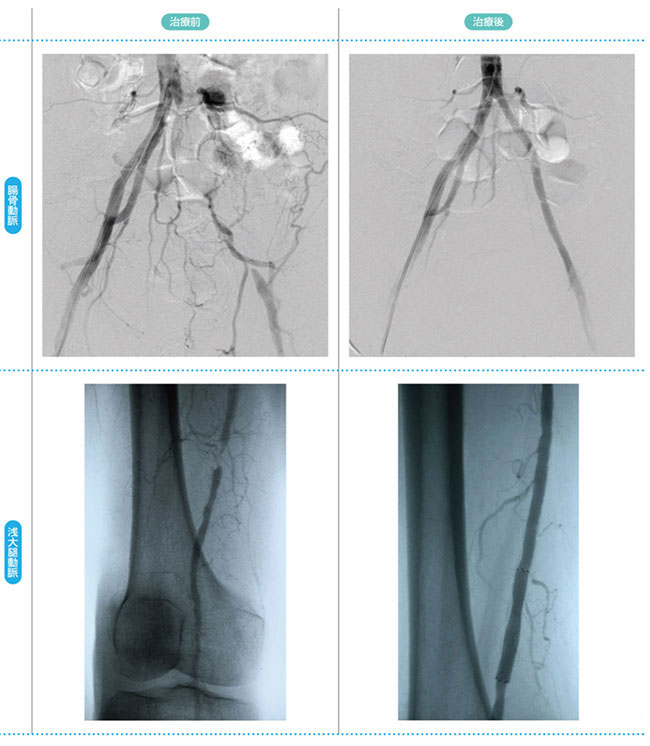
Source: Atlas of Cardiovascular Disease for Informed Consent


