Medical Research Institute KITANO HOSPITAL, PIIF Tazuke-Kofukai
Inquiry
search
close


Departments
An umbilical hernia is what is commonly known as a "belly button protrusion." The belly button is the place where the umbilical cord passes through the abdominal wall when the baby is inside the mother's womb. Normally, after the umbilical cord falls off, the hole in the abdominal wall at the belly button closes tightly, but if the hole remains, it becomes an umbilical hernia (belly button protrusion). It occurs in 1 in 5 to 10 people.
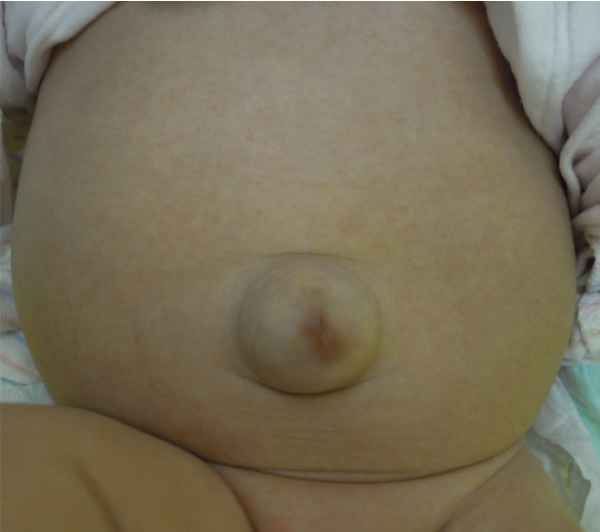
At first visit
For most people, the hole in the abdominal wall closes naturally by around the age of one, and the umbilical hernia is cured. However, if the belly button is left in a swollen state for a long time, the skin around the belly button may become too stretched, ultimately resulting in an unattractive belly button. To prevent this, our clinic recommends compression therapy. Compression therapy involves holding down the protruding belly button with a cotton ball and securing it with clear medical tape. Patients should continue this at home until the hole in the abdominal wall closes.
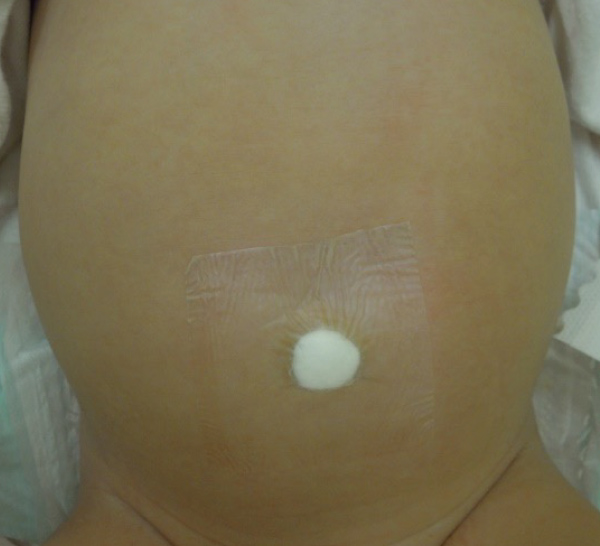
Compression therapy
Most umbilical hernias heal naturally by the time a child is about one year old (the hole in the abdominal wall closes). However, there are some children whose umbilical hernia (belly button protrusion) remains even after they turn one year old. Although an umbilical hernia does not pose a health risk, surgery may be performed to improve appearance. If you are concerned about the shape of your navel, please contact us.
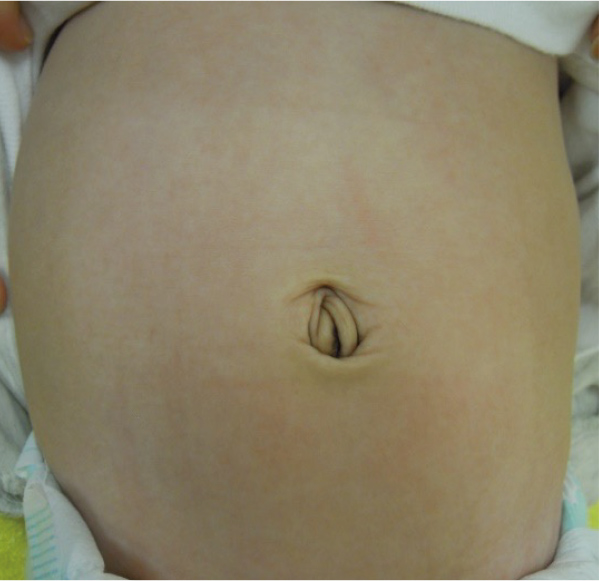
At 5 months


