Medical Research Institute KITANO HOSPITAL, PIIF Tazuke-Kofukai
Inquiry
search
close


Departments
There is a bag filled with fluid inside the scrotum, causing it to swell. In some cases, the bag filled with fluid feels hard to the touch, making it appear as if there is another testicle. Generally, there is no pain.
Hydrocele in children occurs when a narrow passage connects the inside of the abdomen to the scrotum, and water from inside the abdomen (ascites) passes through this passage and accumulates in a sac inside the scrotum.
Both hydrocele and inguinal hernia are caused by the passage leading from inside the abdomen. When the passage is large, organs such as the intestines enter the pouch from inside the abdomen. This condition is called an inguinal hernia. On the other hand, when the passage is narrow, organs cannot enter and only ascites accumulates. This condition is called a hydrocele. It can sometimes be difficult to distinguish between an inguinal hernia and a hydrocele, so an ultrasound scan may be performed.
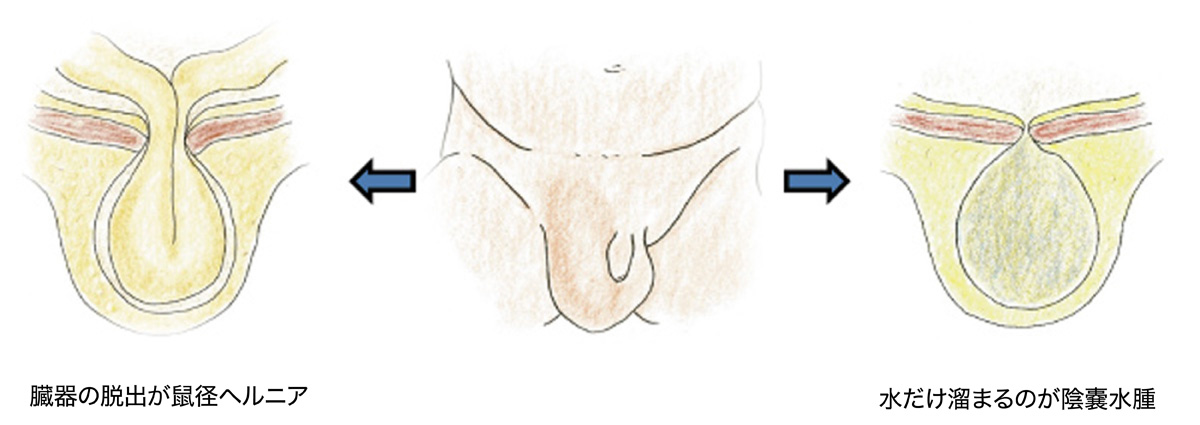
A hydrocele is a swelling of the scrotum, but generally does not cause any serious harm. It is often seen in infancy, and usually shrinks by the time the child is about one year old. However, there are some patients whose scrotum remains large even after they turn one year old. In such cases, surgery may be performed for cosmetic reasons. The surgery involves closing the passageway through which water passes from the abdominal cavity, and is basically the same as surgery for an inguinal hernia. Our hospital uses laparoscopic surgery, which leaves a small incision.


