Medical Research Institute KITANO HOSPITAL, PIIF Tazuke-Kofukai
Inquiry
search
close


Departments
Many people visit the doctor with symptoms such as red or black stool or blood in the stool. The cause can often be roughly determined by examining the patient's age and the state of the blood in the stool. This can also help with diagnosis if the patient has abdominal pain, fever, anemia, etc.
This is the most common condition that causes bloody stools in children (this is the majority of cases). Many people visit the doctor with symptoms such as anal tearing during bowel movements and blood dripping into the toilet bowl.
The best way to prevent anal tears is to take medicine to soften the stool, or you can use an ointment to apply to the anus.
These are benign colon polyps that appear in children around the age of one. Some can exceed 2cm in size. Symptoms include red blood in the stool, and generally no abdominal pain. Diagnosis is by colonoscopy, and if a polyp is found, it is removed with colonoscopy. Generally, it has no bearing on recurrence or colon cancer, and treatment is complete once it is removed.
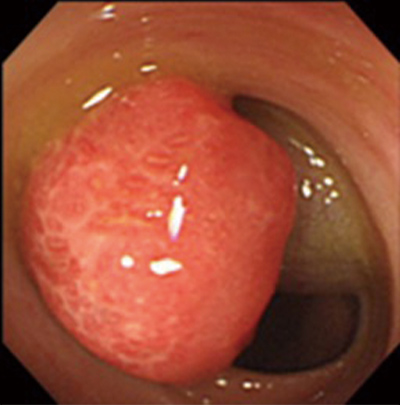
Juvenile polyps
It is rarely seen in children from the middle years of elementary school. It can be detected when the stool turns black and anemia occurs. It can also be caused by Helicobacter pylori, in which case eradication treatment is performed. However, in children, the cause may be unknown, making treatment difficult. Diagnosis is made with a gastroscopy.
Examples include ulcerative colitis and Crohn's disease. It is commonly seen in junior high school students and manifests with symptoms such as bloody stools, diarrhea, and abdominal pain. It is designated as an incurable disease and requires specialized treatment. If you suspect you have it, we recommend a colonoscopy test.
*There are many other causes of bloody stools in children. If your child has bloody stools, we recommend that you take them to a doctor or have them examined.
Children's gastroscopy and colonoscopy
At our hospital, with the cooperation of our gastroenterology department, we are able to perform gastrointestinal endoscopy on newborns and older. Endoscopy can be very frightening for children. However, it is an absolutely necessary test for diagnosing and treating illnesses. To make endoscopic examinations for children as painless as possible, we work with our anesthesiology department to ensure that the examination and treatment are performed while the patient is asleep. Please feel free to consult us about gastrointestinal endoscopy for children.


