Medical Research Institute KITANO HOSPITAL, PIIF Tazuke-Kofukai
Inquiry
search
close


Departments
Experienced specialists support the health of patients.
We aim to provide safe and secure medical care by providing gynecological surgery by a highly qualified oncologist and certified endoscopists (laparoscopy and robotics), as well as a variety of drug therapies and radiation therapy.
The first lymph node that cancer cells reach via the lymphatic system is called the "sentinel lymph node." The procedure of detecting and removing this sentinel lymph node and examining it under a microscope for cancer metastasis is called a "sentinel lymph node biopsy." Confirming that the sentinel lymph node is free of metastasis also determines that other lymph nodes are free of metastasis, preventing unnecessary lymph node dissection. Avoiding unnecessary lymph node dissection reduces complications such as lymphedema. This concept has already been covered by health insurance in the treatment of breast cancer and malignant melanoma, and several clinical studies have demonstrated its usefulness in uterine cancer, so it is expected to be widely adopted in the near future. Our hospital is conducting sentinel lymph node biopsies for uterine cancer as part of a clinical study. If intraoperative rapid pathology testing shows no metastasis to the sentinel lymph node, we omit part of the pelvic lymph node dissection in cervical cancer, striving to reduce complications such as postoperative lymphedema.
Uterine malignant tumor surgery (radical surgery for uterine cancer and cervical cancer), which has traditionally been performed using open surgery, can now be performed as laparoscopic surgery covered by health insurance if certain criteria are met. Our hospital is a certified facility that can perform laparoscopic uterine malignant tumor surgery covered by health insurance. Surgery is performed responsibly by a gynecological oncologist and a certified gynecological endoscopic technician.
For uterine cancer that is preoperatively diagnosed as stage IA, laparoscopic uterine malignant tumor surgery, including lymph node dissection, can be performed as covered by insurance.
For cervical cancer, our hospital currently considers laparoscopic radical hysterectomy (combined with sentinel lymph node biopsy as part of clinical research) appropriate for cases in which the maximum diameter of the tumor is 2 cm or less. If the maximum diameter of the tumor exceeds 2 cm, we recommend open radical hysterectomy. Additionally, laparoscopic (or open) radical trachelectomy is also appropriate for cases in which the maximum diameter of the tumor is 2 cm or less.
Radical trachelectomy is a surgical procedure to remove only the cervix for early stage cervical cancer (stages IA2 to IB1). It is the only surgical treatment that can preserve fertility in patients with cervical cancer who would normally require a total hysterectomy.
Our hospital has been performing this trachelectomy for some time, and many patients have become pregnant. However, whether trachelectomy can be performed safely must be determined after a thorough evaluation of the size, location, and tissue type of the cancer.
For more information, please consult your outpatient doctor.
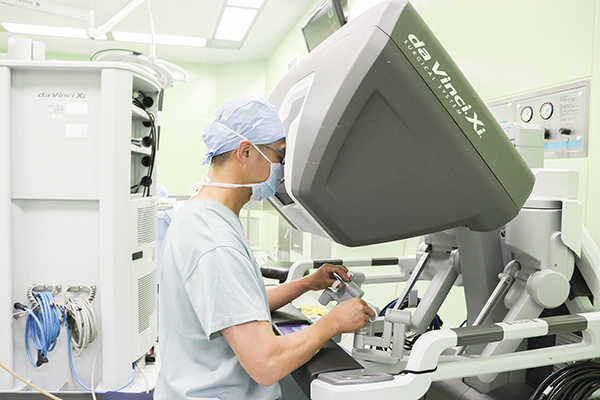
Our hospital began offering robotic surgery (robotic-assisted total hysterectomy) for benign conditions such as uterine fibroids as a covered medical treatment in October 2019. Robotic surgery allows for surgical operations with a 3D field of view, and the robotic arm has the advantage of allowing for safe operation that would be difficult with conventional laparoscopy. Furthermore, robotic surgery for uterine cancer also began in October 2021.
We currently have doctors on staff who are certified as proctors (supervising physicians) for all robotic surgeries, including sacrocolpopexy, and we perform a variety of uterine prolapse surgeries after carefully considering the appropriateness of the procedure.
If you have a pathogenic mutation in the BRCA gene and are diagnosed with hereditary breast and ovarian cancer syndrome (HBOC), risk-reducing surgery (prophylactic removal of the ovaries and fallopian tubes before the onset of ovarian cancer in order to lower the risk of ovarian cancer) is recommended between the ages of 35 and 40 after you have finished having children. It has been reported that only risk-reducing surgery can reduce the risk of ovarian cancer and the mortality rate from ovarian cancer. If there are no underlying diseases or complications, laparoscopic surgery can be performed. As of April 2020, some of this surgery has been covered by insurance.
In close collaboration with the oncologists in charge of anti-cancer drug treatment at our hospital and the Chemotherapy Center, we are able to provide a variety of anti-cancer drug treatments, including immune checkpoint inhibitors.
With a team of doctors with extensive experience in gynecological surgery, we are able to handle a variety of surgical procedures, not only performing advanced open surgery but also proactively introducing laparoscopic surgery and sentinel lymph node biopsy to provide minimally invasive surgery that places less strain on patients.
We offer fertility-preserving procedures for various diseases, including endometriosis, uterine fibroids, adenomyosis, and early-stage cervical cancer. We also work in cooperation with infertility treatment clinics to enable patients to begin infertility treatment as quickly as possible.
| Simple hysterectomy | 96 cases (39 open cases, 55 laparoscopic cases, 2 robotic cases) |
|---|---|
| Benign ovarian tumor removal | 135 cases (5 open cases, 130 laparoscopic cases) |
| Myomectomy | 17 cases (14 open cases, 3 laparoscopic cases) |
| Ectopic pregnancy surgery | 14 cases (0 laparotomy, 14 laparoscopic) |
| Pelvic organ prolapse surgery | 10 items |
| Hysteroscopic examination and surgery | 224 cases (39 lumbar hemp cases, 185 ward surgery cases) |
| Cervical conization | 123 cases (38 lumbar hemp cases, 85 ward surgery cases) |
| Radical hysterectomy | 10 cases (8 laparotomy, 2 laparoscopic) |
|---|---|
| Radical trachelectomy | 1 case (laparotomy 0 cases, laparoscopic 1 case) |
| Modified radical hysterectomy | 5 cases (3 laparotomy, 2 laparoscopic) |
| Uterine cancer surgery | 35 cases (14 open cases, 12 laparoscopic cases, 9 robotic cases) |
| ovarian cancer surgery | 34 items |
| Recurrent cancer surgery (including IDS) | 4 items |
| others | 19 items |
| Total gynecological surgery | 727 items |
|---|