Medical Research Institute KITANO HOSPITAL, PIIF Tazuke-Kofukai
Inquiry
search
close


Departments
On April 1, 2025, a clinical nurse room was opened at Medical Research Institute Kitano Hospital.
A nurse practitioner (NP) is a professional who has completed a graduate school NP training course after five or more years of practical experience as a nurse, and passed the NP certification exam. Under the direction of a physician, NPs perform 38 acts in 21 categories of specific nurse acts in accordance with the specific nurse act procedure manual, as well as assessing patients' conditions and managing their symptoms. NPs also serve as a bridge between patients, doctors, and nurses. The Clinical Nurse Office oversees and manages the NPs currently employed, and is responsible for everything from NP education to labor management, as well as collaboration with each medical department. While still a new department, the Clinical Nurse Office and NPs work together to strive to provide better medical care.
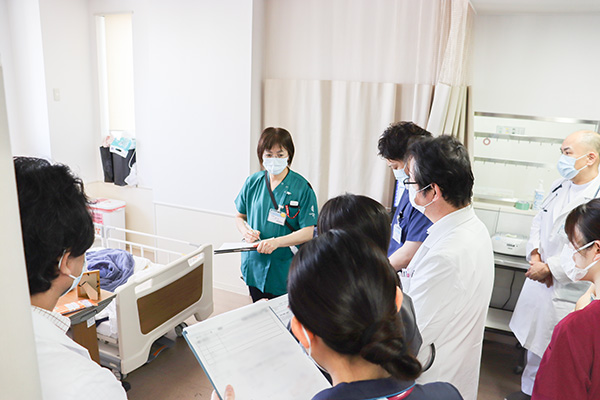
Multi-disciplinary rounds
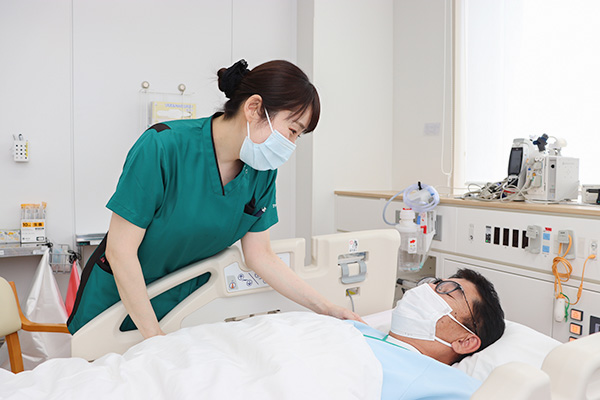
Ward work
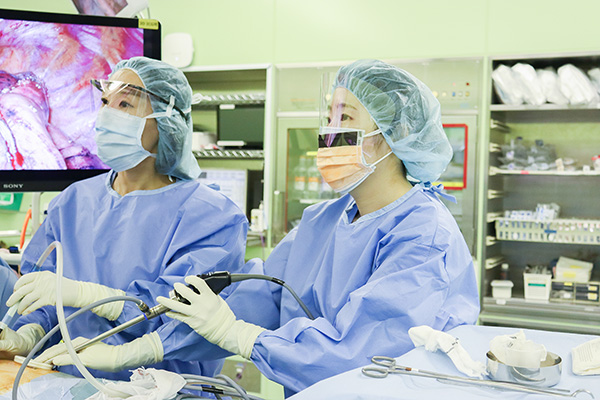
Surgical assistance
The nurse practitioner (NP) system was launched in 2008, with education modeled on that of nurse practitioners in the United States. Those who complete a graduate school NP training course certified by the Japan Council of Graduate Schools of NP Education and pass the NP qualification examination are called NPs.
While NPs are able to carry out all of the 38 items in the 21 categories established as specific acts, they go beyond these frameworks and play a role in supporting medical practice by working with doctors to carry out relative medical acts, etc. Also, when doctors are performing surgery or outpatient work and there are no doctors on the wards, etc., NPs can provide timely medical treatment according to the patient's symptoms, preventing the condition from worsening and improving the patient's quality of life.
Therefore, NPs are required to have the ability to provide medical care autonomously (responsibly and at their own discretion) except for absolute medical acts.
At our hospital, NPs are called Kitano Nurse Practitioners (KNPs), and they work in the KNP room, being seconded to each medical department. If the department in which each NP wants to work matches the department that is looking for an NP, they will be able to work in that department. The content of the work will be decided in consultation with the NP based on their motivation and wishes.
For new NPs, we are currently adjusting the program to include rotational training, so even if they have just graduated from graduate school and obtained their qualifications, they will be able to receive guidance and training from supervising physicians and senior NPs.
There are an increasing number of medical departments that want to work with NPs and ask for their help.
I originally worked as a Wound, Stoma and Continence Nurse (WOCN) in the stoma outpatient clinic and as an expert nurse in bedsore and wound management. Wanting to provide even better wound management, I learned about NP qualifications and decided to go on to graduate school.
After obtaining my NP qualification and completing two years of rotational training, I became involved in cardiovascular surgery admissions and perioperative management, working with doctors to provide discharge support from a nurse's perspective.
On surgery days, I work as an NP, responsible for the initial response of patients in the intensive care unit and wards, where doctors are not present. The nurses I work with praise me for being able to ask questions at any time, consult with me when I have a problem, and receive immediate assistance. I myself would like to be able to provide uninterrupted, seamless medical care, and I intend to continue to train myself.
Would you like to work with us to achieve your goals as a NP?
In the cardiovascular surgery department, an NP from the emergency department began participating once a week in December 2023, and later increased to twice a week. This led to the hiring of a dedicated NP in April 2024, and currently, a total of four people, three surgeons and one NP, carry out daily operations.
Our dedicated NPs do not directly participate in surgery, but instead support peripheral tasks other than surgery, based on the idea that "we want surgeons to concentrate on surgery." Specifically, they are responsible for the following tasks:
These are areas that surgeons tend to put off and find it difficult to adequately address, but NPs can provide appropriate support. Our department's dedicated NPs have over 10 years of experience as NPs in addition to many years of nursing experience, and are able to provide accurate support. As a result, they have earned an excellent reputation among those around them, and are known for being "someone who can reach out to those who need help."
Currently, the number of cardiovascular surgeons is decreasing and aging throughout Japan, and our department is currently operating with only three surgeons. As a result, there are many cases where surgeons are absent from the wards or ICU, but in those cases, NPs act as a bridge between doctors and nurses, and depending on the situation, they act on behalf of surgeons to give instructions to nurses at their own discretion, coordinate with other departments, and provide explanations to patients and their families.
The introduction of NPs has made medical treatment smoother and more seamless not only in the cardiovascular surgery department but throughout the cardiac center as a whole, contributing to an increase in the number of cases and improved outcomes. NPs have now become an indispensable presence.
With the establishment of the "KNP Room," we believe that if NPs are placed in other departments as well, the quality of medical care at Kitano Hospital as a whole will further improve and the number of cases will also increase.
This pagePlease check.


