Medical Research Institute KITANO HOSPITAL, PIIF Tazuke-Kofukai
Inquiry
search
close


Departments
IgA nephropathy is a common disease that begins in young people with hematuria, progresses asymptomatically, and progresses to kidney failure in approximately 30% of patients within 20 years, necessitating dialysis. Early-stage cases with mild hematuria are recommended to undergo short-term (5-day) hospitalization for testing, while cases likely to progress are admitted for short-term (2-week) hospitalization for treatment including pulse therapy, after which treatment continues on an outpatient basis.
For nephrotic syndrome that does not respond to steroid treatment, we further treat it with cyclosporine (Neoral), and for hypercholesterolemia associated with nephrosis, we perform LDL apheresis therapy in an effort to speed up the onset of remission and reduce the amount of steroids administered.
For patients with chronic renal failure, we have begun hemodialysis and CAPD therapy with the patient's active consent. Furthermore, we provide emergency and maintenance blood purification therapies tailored to each disease, such as ECUM (ultrafiltration), plasma exchange, endotoxin adsorption therapy, LDL adsorption therapy, cryofiltration, and concentrated ascites reinfusion. For secondary hyperparathyroidism, we also provide drug therapy and perform parathyroidectomy to prevent the progression of bone lesions.
Nephrology deals with various kidney diseases such as nephritis and nephrosis, which can be broadly divided into two types: those that first affect the kidneys (primary kidney disease) and those that are caused by a systemic disease that affects the kidneys (secondary kidney disease).Since the treatment for each type is different, kidney biopsy is an important tool for making a clear diagnosis.
Furthermore, regardless of the cause, as the condition progresses, the kidneys' power will decline and kidney failure will occur. At this point, blood or peritoneal dialysis will be required as an artificial kidney to compensate for the lost kidney function. Below we will explain the most common kidney diseases and explain how they are treated at our hospital.
Our hospital accepts patients for examinations according to the following schedule:
The kidney biopsy results will then be analyzed on the following Tuesday, and you will be asked to come to the hospital to receive an explanation of the results and future treatment options. Depending on the results, you may need to be readmitted to the hospital for further treatment. (Depending on the test results, further analysis may take some time.)
 This is a disease that occurs suddenly 2 to 3 weeks after a cold, tonsillitis, or skin infection.
Symptoms include hematuria, proteinuria, high blood pressure, and edema (swelling of the body). In severe cases, kidney function may decline and urine output may decrease. Although it is more common in children, it can also occur in adults.
Most cases improve with rest and diet alone, but depending on the severity, oral medication may be necessary.
Most people recover completely within 3 to 6 months, but in rare cases, the condition may become chronic or progress rapidly. Detailed examinations such as a kidney biopsy are necessary. At our hospital, we can perform a kidney biopsy to determine the prognosis and consider appropriate treatment.
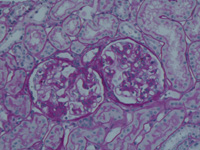 This condition occurs over a long period of time, with blood and protein in the urine and high blood pressure.There are often no noticeable symptoms, and the condition may be discovered when abnormal urine is detected during school or workplace health checkups.
The cause is often unclear, but since it can worsen from infections such as colds, it is thought to be triggered by some kind of viral or bacterial infection.
As the disease progresses slowly, kidney function declines, leading to chronic renal failure and uremia. There are various types, and treatment varies depending on the degree of progression, so a kidney tissue examination (renal biopsy) may be necessary.
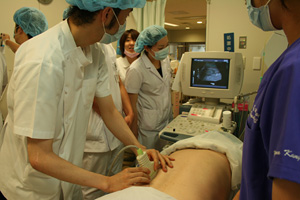
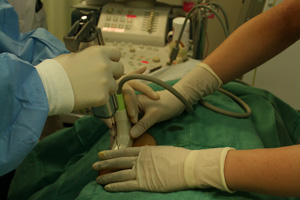
At our hospital, we perform approximately 100 kidney biopsies per year and decide on treatment based on the findings (photo on the right).
As the condition progresses, the kidneys shrink and this test becomes impossible, so if you are told that you have abnormal urine, we recommend that you consult a doctor as soon as possible.
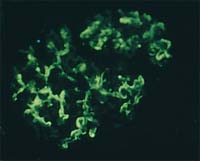 This is a type of chronic nephritis that is very common among Japanese people, and is discovered when a patient discovers blood in their urine (macroscopic hematuria) or when it is pointed out during a health check (positive urine occult blood test).
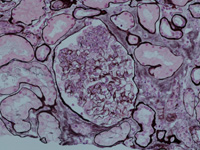
It is characterized by the deposition of the immune protein IgA in the glomerulus, a part of the kidney that produces urine (photo on the right showing IgA deposition in the glomerulus in IgA nephropathy).
This IgA is normally found in the mucous membranes of the nose, throat, intestines, etc., and protects the body from foreign substances, but in this disease it clumps and deposits in the kidneys, causing damage. Some people have mild symptoms and the condition does not progress, but about 30% of people will develop chronic kidney failure within about 20 years if left untreated, requiring dialysis.
In order to stop the progression of this disease, at our hospital, we perform a kidney biopsy as soon as we find abnormalities in the urine and administer medications such as steroids as necessary.
Tonsillectomy is also said to be effective for people prone to tonsillitis. Even if you have no symptoms, it is important not to leave it alone and to continue to manage it.
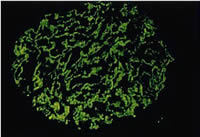 This is a disease in which a lot of protein is excreted in the urine, reducing the amount of protein in the body, causing water to accumulate in the body, making it difficult to urinate and causing severe swelling.
Although it is a type of chronic nephritis, there are many diseases that can cause it, and the treatment varies depending on the cause, so a diagnosis is still required by kidney biopsy (photo on the right shows IgG glomerular deposition in membranous nephropathy presenting as nephrosis).
Since the cause is an immune disorder, treatment involves the use of steroids or immunosuppressants to suppress the immune system. While some types of the disease can easily eliminate the protein with steroids, there are also types that do not respond well to various treatments.
It is also often accompanied by hypercholesterolemia, which can damage the kidneys and weaken the effectiveness of medication, so at our hospital we use cholesterol adsorption therapy to help the medication work faster, which shortens the length of hospital stay and reduces the side effects of medication.
Rapidly progressive glomerulonephritis
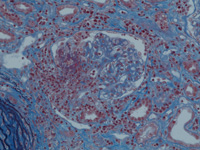 This is a disease in which blood and protein are found in the urine in urine tests, and kidney function deteriorates rapidly over a period of several weeks to several months.
The main symptoms include low urine output, swelling, fatigue, and loss of appetite, and sometimes muscle and joint pain, fever, numbness in the hands and feet, cough, and phlegm may also be seen.
If left untreated, the condition will inevitably lead to end-stage renal failure and uremia, so it is important to make a diagnosis early and begin treatment.
There are various types, and an accurate diagnosis requires a kidney tissue examination (renal biopsy), but if the kidneys are atrophied, a kidney biopsy may not be possible.
At our hospital, we try to confirm the diagnosis with a kidney biopsy whenever possible before deciding on a treatment plan, but if a kidney biopsy is not possible, we start treatment after making a comprehensive judgment based on blood tests, urine tests, etc. Although it is a relatively rare disease, it has been increasing recently among elderly people, and our hospital has extensive experience in treating it.
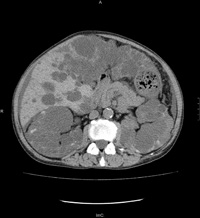 This is a disease in which sacs (cysts) that store urine develop in various parts of the kidneys from a young age.At first, they are small and go unnoticed, but after middle age they grow larger and press on the normal parts of the kidney, impairing their function, leading to the progression of high blood pressure, proteinuria, and decreased kidney function.
Cysts can also occur in the liver, pancreas, and other organs, not just the kidneys (CT image of polycystic disease in the kidneys and liver).
Most people have family members with the disease, and it is a genetic disorder.
The gene has now been analyzed, making it possible to diagnose whether the gene will be present in the child. Those who have developed the disease are monitored over the long term and treated with medication to prevent the condition from progressing to kidney failure.
Additionally, our hospital strives to improve quality of life by providing decompression, sclerotherapy, and arterial embolization therapy for enlarged cysts.
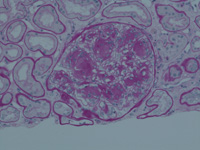 It is one of the serious vascular complications caused by poor diabetes control.
Diabetic nephropathy begins with the appearance of protein in the urine, so urine tests should be performed regularly throughout the course of diabetes. As symptoms progress, swelling appears.
In the final stages, kidney failure (kidney death) occurs and dialysis treatment becomes necessary. The number of patients undergoing dialysis due to diabetic nephropathy is increasing year by year, so it is important to start appropriate treatment early on in the course of nephropathy.
When nephropathy develops, the treatment differs from conventional diabetes, requiring not only oral medication at the hospital but also self-administered dietary and exercise therapy. For this reason, our hospital conducts educational hospitalizations when nephropathy appears.
We also provide a range of treatments, from kidney failure management to dialysis treatment.
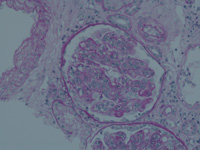 This is a kidney disease associated with the autoimmune disease systemic lupus erythematosus (SLE), and can present with a variety of symptoms, ranging from mild hematuria to severe proteinuria and a decline in kidney function leading to kidney failure.
Antibodies are produced against the nuclear components of cells, which are part of the body (antinuclear antibodies), and these clump together and deposit in the kidneys, damaging the tissue.
People with SLE are always at risk of developing this nephritis, so they should pay close attention to their urinary findings and, if any abnormalities are found, undergo a kidney biopsy early and recommend treatment.
At our hospital, in addition to kidney biopsies, we also improve the efficiency of treatment by using apheresis therapy to remove antinuclear antibodies that damage the kidneys and the immune complexes that form these antibodies.
Hepatitis virus-associated nephritis
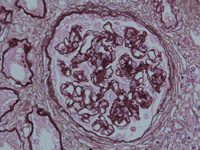 This is a type of nephritis caused by hepatitis B or C virus, and occurs in people with hepatitis or cirrhosis, but asymptomatic carriers can also develop the disease.
Proteinuria is common and nephrotic syndrome is also common, but there is also a type in which renal function declines even if urinary abnormalities are not severe.
At our hospital, we use kidney biopsies to detect viral fragments for diagnosis.
Once a diagnosis is made, interferon therapy or steroid therapy is used to eliminate the virus. However, since treatment may be delayed, if you test positive for these viruses and are told that your urine is abnormal, we recommend that you undergo detailed testing as soon as possible.
This is a condition in which kidney function declines and nitrogen metabolites (typically urea and creatinine) are no longer sufficiently excreted in urine.
A condition in which blood urea nitrogen (BUN) and creatinine levels are persistently elevated. It can be divided into acute renal failure and chronic renal failure.
When kidney failure occurs, the kidneys lose their ability to:
This can result in the following symptoms and abnormal test results:
At our hospital, we provide guidance to patients with kidney failure by distributing pamphlets and other materials on various treatments and precautions to take in daily life.
This refers to a sudden decline in kidney function over a period of days or weeks. When a cause of serious kidney damage occurs (such as major bleeding, shock, drug poisoning, serious infection, trauma, or burns), kidney function rapidly declines and blood urea nitrogen and creatinine levels continue to rise.
When the disease develops, it usually becomes difficult to urinate (less than 400 ml/day), but it is rare for the urinary output to be completely blocked. In some cases, even though urine is still being produced, kidney function may decline and azotemia may occur.
In the final stages, dialysis treatment is required, but if there are no other serious illnesses, there is hope for recovery of kidney function.
At our hospital, when the underlying disease is unknown, we perform a kidney biopsy whenever possible to identify the cause and provide treatment to help the patient recover from kidney failure.
This is a condition in which kidney function gradually declines over a period of months or years, and waste products (nitrogen metabolites) can no longer be sufficiently excreted in the urine.
Common causes of chronic renal failure in Japan include:

It is also true that even if 70-80% of healthy functions are lost, there are often no noticeable symptoms.
 However, during this period, high blood pressure, anemia, and blood acidity are often observed, and it has been found that people who receive treatment are able to maintain a comfortable daily life, their kidney function deteriorates more slowly, and they are less likely to suffer from after-effects.
At our hospital, we treat these symptoms by administering medication, hormone injections, and dietary therapy on an outpatient basis to help patients maintain as normal a state as possible, and provide treatment and guidance to slow the progression of kidney failure.
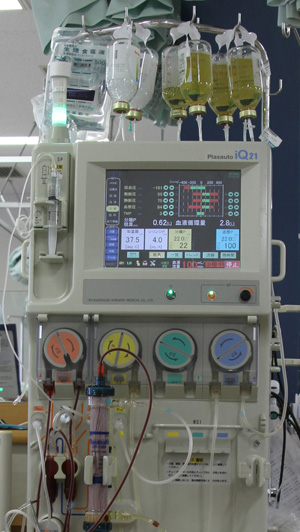
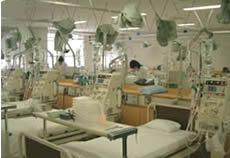
However, if kidney function falls below 10% and uremia progresses, the patient will be treated with dialysis or CAPD therapy using a peritoneal membrane at the Blood Purification Center (23 beds in total, photo), depending on the patient's needs. We also offer consultations regarding transplant treatment.


