Medical Research Institute KITANO HOSPITAL, PIIF Tazuke-Kofukai
Inquiry
search
close


We will hold a kidney disease workshop to raise awareness of kidney disease.
Please bring your family along too.
Please note that the contents may be subject to change.
| place | Main Building 5th Floor Kitano Hall |
|---|---|
| Time | 14:30-15:45 |
| Participation is free | |
| Date | manager | Content |
|---|---|---|
| May 22 (Thursday) September 25th (Thursday) |
Doctor | About the Kidneys Chronic kidney disease and its treatment |
| June 26th (Thursday) October 23rd (Thursday) |
clinical laboratory technician pharmacist |
What the test reveals About kidney disease medications |
| July 24th (Thursday) November 27th (Thursday) |
Registered dietitian | You can start today! Dietary therapy basics and tips Seasonal precautions |
| August 28th (Thursday) January 22 (Thursday) |
nurse Physical therapist medical social worker |
Recommendation for quitting smoking Chronic kidney disease and exercise therapy What welfare systems are available? |
*You can participate in this class without making a reservation.
For inquiries, please contact: Kitano Hospital Blood Purification Center at 06-6312-1251 (direct line)
A follow-up course for instructors of the Neonatal Resuscitation and Cardiac Resuscitation (NCPR) specialist course, certified by the Japanese Society of Perinatal and Neonatal Medicine, will be held at our hospital on Sunday, June 8, 2014.
This is the first follow-up for Course I in the Kansai region.
Applications are accepted on a first-come, first-served basis, so please apply early via the website below.
Kitano Hospital NICU offers on-site training courses for NCPR (Course B), a neonatal resuscitation method approved by the Japanese Society of Perinatal and Neonatal Medicine.
Our staff will use a resuscitation doll to give lectures and practical training at your facility. At the end of the course there will be a written exam, and you can also obtain a license that is valid for five years.
For inquiries, please contact Mizumoto (h-mizumoto(at)kitano-hp.or.jp (replace (at) with @)).
Our hospital has been certified as a training site in the Kansai region for the Neonatal Resuscitation Promotion Project sponsored by the Japanese Society of Perinatal and Neonatal Medicine.
In 2014, we plan to hold two instructor training courses (I Course) at our hospital.
For more information, please see the website of the Japan Society of Perinatal and Neonatal Medicine (http://www.ncpr.jp/guideline/concept_training.html) for more information.
Report on the 6th Kitano Cooking Class (October 12, 2013)
Dr. Yoshiko Iwaki retired from our hospital at the end of October.
Helicobacter pylori, a bacterium that lives in the gastric mucosa, is positive for more than half of people over the age of 40, and is closely related to gastritis, gastric ulcers, and stomach cancer. Until now, blood antibody tests could only determine whether or not a person had been infected in the past, and diagnosing H. pylori required a urea breath test or a biopsy with a gastroscope. People who have H. pylori in their stomach excrete the bacteria in their stool, so a stool H. pylori antigen test can determine whether the bacteria are actually present.
When you undergo a health checkup, you can add this test as an option.
Additional inspection fee: 5,250 yen
If you are interested, please contact the Kitano Hospital Health Management Center in advance.
Direct line number (TEL 06-6312-8841)
The oldest patient at Kitano Hospital, a 92-year-old man, underwent valve replacement surgery (valve replacement) for severe heart valve disease on March 27, 2013. He experienced no postoperative complications, actively participated in rehabilitation, and was discharged safely and in good health on April 20.
Although this patient was generally in good health, he was over 90 years old, and all of us at the Heart Center discussed very carefully whether or not to perform surgery.
He was admitted to the hospital in February 2012 due to heart failure, and although his condition improved with medical treatment, he required treatment for severe valvular disease (the difference in pressure between the left ventricle and aorta, an indicator of severity, was 150mmHg; normally there is no difference). At this point, we considered catheter-assisted valve replacement surgery (known as TAVI or TAVR), which is said to be gentler on the body than the usual open-chest cardiac surgery using an artificial heart. Only four facilities in Japan are currently permitted to perform this procedure, and we requested treatment from one of them. After further consideration, we found that his heart shape was unsuitable for catheter-assisted surgery, and we were forced to abandon the plan.
After that, the patient was given oral medication, including diuretics, at our hospital's cardiac center outpatient clinic, but the heart failure was difficult to control, so we again discussed open-chest heart surgery with the patient and his family. The patient, who was in good health, resolutely replied, "I'm a little scared, but I'll do my best and undergo the surgery." We medical staff were encouraged by these powerful words and did our best to treat him.
I believe the patient's positive attitude contributed to this positive outcome.
We are extremely grateful to all the cardiac center staff involved in the treatment.
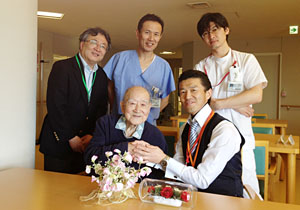
Kitano Hospital, Cardiac Center, Chief of Cardiovascular Surgery
Koji Ueyama
| (※) With the patient's kind permission, this article and photograph have been published in the hope that they may provide some courage to the many people suffering from the same disease. |
The Health Management Center moved to the 14th floor of the main building on May 7, 2013.
Previously, tests were conducted on the first floor of the main building, and patients were asked to move to the second medical examination building for the results to be explained, which was inconvenient, but now both tests and results are conducted in the same location, which is much more convenient. Take the elevator to the main building to the 14th floor and you will find the Health Management Center on the west side.
Compared to before, you can now receive your health checkup in a brighter, more spacious space. After checking in, we have prepared a changing room at the very back. There is also a space for women to touch up their makeup. After a chest X-ray, we will measure your height, weight, blood pressure, hearing, vision, and eye fundus. Abdominal ultrasound and gastroscopy are performed on the same floor, the 14th floor. We recommend gastroscopy through the nose, which has been well received as it is easier than the traditional method through the mouth. We also have a section for women to receive breast cancer and gynecological examinations, and whenever possible, female doctors are in charge of breast cancer and gynecological examinations.
At lunchtime, you can enjoy the view from the 14th floor, listen to nutritional advice from a registered dietitian, and enjoy lunch at Hotel New Otani. After lunch, the doctor will explain the results. If there are any problems with the results, you will be asked to make an appointment for additional tests or to see a specialist, and the day checkup will come to an end.
Those undergoing an overnight checkup will stay in a private room in the East Ward on the 14th floor, and in the afternoon will undergo optional tests such as a brain MRI, cardiac checkup, and lung checkup. Dinner will also be prepared by Hotel New Otani. The next morning, you will undergo a glucose tolerance test followed by breakfast. After an eye examination and an explanation of the brain checkup results (if applicable), you will receive an explanation of the results from the internal medicine department, and your overnight checkup will be completed.
The greatest feature of our comprehensive medical checkups is that we provide accurate diagnoses by specialists in each field, and if further examination is necessary, we can refer you to other departments within the hospital. We look forward to seeing you.
Please make a reservation with the Health Management Center (TEL: 06-6312-8841) if you wish to use the facility.
<Health Management Center on the 14th floor of the main building>
| (Examination space) | (Lunch space) | (Full view) | ||
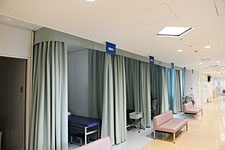 |
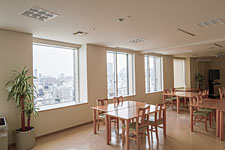 |
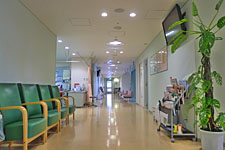 |
(View from the Health Management Center on the 14th floor)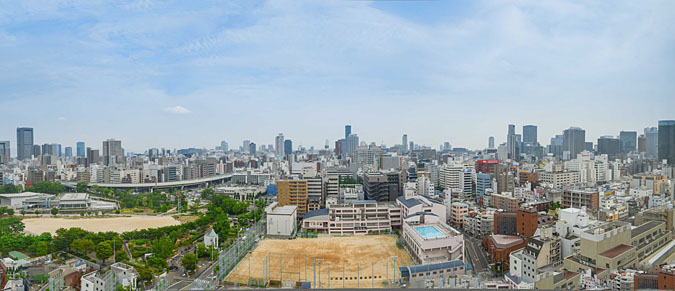
An interview with Dr. Muso Eri, Vice Director of the Medical Research Institute and Chief of the Department of Nephrology at our hospital, was featured in the July 2013 issue of Doctors Magazine (published by Medical Principle Co., Ltd.) in the article "Female Doctors Supporting the Times."
The Diabetes and Endocrinology Center's initiative to introduce specialized nurse outpatient services was introduced on the medical information site Career Brain News (operated by Career Brain Co., Ltd.).
(Article: "Specialized Nurse Outpatient Clinic" helps reduce the burden on doctors - Kitano Hospital's initiative in Osaka)
Link to the publication page here
Normally, water in the body exists as blood or lymph. As blood circulates, oxygen is supplied to tissues, and approximately 10% of the water in the blood leaks out of the blood vessels and enters a circulatory system called the lymphatic system, which returns to the heart. After surgery on the limbs or abdomen or radiation therapy, lymphatic return becomes poor and lymphatic fluid accumulates in the limbs, a condition known as lymphedema. Generally, lymphedema occurs in patients who have undergone abdominal surgery, primarily for gynecological reasons, and appears several years after surgery. However, lymphedema can also occur gradually due to congenital poor development of lymphatic tissue, or for unknown reasons.
If left untreated, edema will progress, increasing the risk of functional disorders such as difficulty walking and the development of infections. Because lymphatic congestion occurs, cellulitis is likely to occur even with minor trauma, and with each recurrence of inflammation, fibrosis progresses around the lymphatic tissue, causing the edema to progress. Eventually, the condition develops into an elephantiasis accompanied by hyperkeratosis of the skin.
Treatment method
1. Lymphaticovenular anastomosis
Ultra-microsurgery technology has made it possible to connect thin lymphatic vessels, which was previously impossible, and has made possible surgical treatments that are less stressful on the body and have excellent therapeutic effects.
In our department, we first inject a dye called indocyanine green (ICG) under the skin before surgery and observe the state of the lymphatic vessels using a special camera. During surgery, we use a Carl Zeiss Pentero surgical microscope equipped with an ICG observation device to accurately anastomose the lymphatic vessels and venules.
2. In addition to compression with elastic stockings and skin care to prevent progression, we also provide lymphatic massage instruction by specialized nurses.
The Kitano Hospital Emergency Department holds emergency training seminars once a month for patients, their families, and the general public. During odd-numbered months, the emergency training seminars include practical training in cardiopulmonary resuscitation ("CPR"), and during even-numbered months, seminars on illnesses of concern ("Lectures").
Let's learn the correct methods and knowledge so that we can respond appropriately in the event of an emergency. Please join us!
This is a training session on cardiopulmonary resuscitation (CPR) techniques such as chest compressions and AEDs, taught by emergency department nurses. Chest compressions and AEDs are taught using actual adult and child dolls.
You're the one who's going to participate. Anyone can participate.
You can also take the course with your children.
| Date and Time |
Odd-numbered months (May, July, September, November, January, March) Second Friday from 10:00
|
|---|---|
| place | Kitano Hospital, 5th floor, Conference Room 6 |
| Event Schedule | place | |
|---|---|---|
| 2013 | May 10 | Conference Room 6 |
| July 12 | ||
| September 13 | ||
| November 8 | ||
| 2013 | January 10 | |
| March 14 | ||
First Aid Training Course <Cardiopulmonary Resuscitation> Poster (PDF)
Emergency department nurses will provide a lecture on various illnesses of concern.
There will also be a Q&A session. You can ask any questions you have, such as "What symptoms will I experience?" or "What should I do in this situation?"
| Date and Time |
Even-numbered months (May, July, September, November, January, March) Second Friday from 10:00
|
|---|---|
| place | Kitano Hospital, 5th floor, Conference Room 6 |
| schedule | Content | place | |
|---|---|---|---|
| 2013 | June 14 | Food poisoning and acute gastroenteritis | Conference Room 6 |
| August 9 | About heatstroke | ||
| October 11 |
About heart disease
|
||
| December 13 |
Influenza and infectious diseases
|
||
| 2014 | February 14th |
About Stroke
|
|
First Aid Training Course <Lecture Edition> Poster (PDF)
Phone: 06-6312-1221
Please make an appointment in person at the Kitano Hospital Emergency Department (1st floor), by phone, or by coming directly to Kitano Hall at 10am on the day of your appointment.
Report on the 5th Kitano Cooking Class (March 9, 2013)


