Medical Research Institute KITANO HOSPITAL, PIIF Tazuke-Kofukai
Inquiry
search
close


A nurse who has acquired skilled nursing techniques and knowledge in a specific nursing field and contributes to improving the quality of nursing care is called a resource nurse.
At our hospital, we have specialist nurses and certified nurses who have passed the certification examination of the Japanese Nursing Association, as well as over 20 people who have completed the specific practice training set by the Ministry of Health, Labor and Welfare, working as resource nurses.
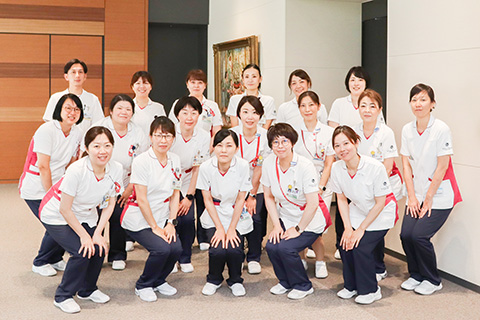
As cancer nursing specialist nurses, we understand the physical, psychological, social, and spiritual pain that cancer patients experience, and provide care in collaboration with multiple professions, aiming to improve their quality of life (QOL).
We are conscious of the nursing perspective of supporting the lives of people living with cancer so that they can live in a way that is true to themselves, and we strive to be close to patients and their families, supporting them in making decisions based on the values and beliefs that they hold dear, and believing in and bringing out the innate strengths of cancer patients and their families.
Furthermore, in order to ensure that high-quality cancer nursing is provided, I would like to cherish opportunities to educate nurses and to reflect together on the nursing they are practicing.In addition, since ethical issues are often encountered in clinical practice and nurses are required to have an ethical attitude, I would like to create a forum where ethical issues can be discussed.
Through my interactions with cancer patients, I consider not only physical pain but also psychological, social, and spiritual pain comprehensively, and think about how I can provide better support every day, and put it into practice. I believe that no two people share the same values, so I would like to provide ongoing support that takes into consideration the values, hopes, and lifestyle of each cancer patient, involving not only ward staff but also multidisciplinary staff, so that they can live the life that is true to them.
Furthermore, from the day their loved one is diagnosed with cancer, the family members who support the cancer patient also become "second patients" and experience pain unique to the family of a patient. Therefore, we would like to provide support not only to cancer patients, but also to their families.
My main focus is consultations on stoma and incontinence management. I work with staff at the bedside to provide wound care, stoma care instruction, fistula care, and skin care. I also make home visits to patients with stomas and pressure ulcers. I consider home care methods and issues, and provide support for daily life. For specific procedures, I remove necrotic tissue and perform closed negative pressure therapy under the comprehensive instructions of a doctor.
As a pressure ulcer manager, I work across the hospital's organizational boundaries.
We hold regular training sessions and provide group education to ensure that our staff have sufficient knowledge and skills. We also manage data to understand trends at our hospital and work to solve problems.
For patients at risk of developing pressure ulcers, we work with ward staff to assess them and provide guidance and practice on preventative measures such as skin care and body pressure management.
If a patient has a bedsore, we discuss the treatment plan with the doctor and provide treatment and prevent it from getting worse. In addition, a multidisciplinary team makes rounds once a week to check on patients. Each team member utilizes their expertise to provide care for bedsores, aiming for early healing.
Outside the hospital, we also share information with local residents, including visiting nurses, to provide care to prevent and treat pressure ulcers.
We are looking for an Infection Control Certified NursePlease refer to the linked page for details.
As a certified infection control nurse, I work to protect patients, their families, and medical professionals from healthcare-associated infections. I currently work in a mixed ward for orthopedics and respiratory medicine. Every day, I work on-site to check the implementation of infection control measures by nurses, doctors, and other professionals, and provide staff education to strengthen infection control measures.
We strive to strengthen infection control measures every day so that we can provide safe, secure, and high-quality care to our patients.
I obtained my infection control certified nurse certification in 2014 and joined Kitano Hospital in April 2019. I currently work in the emergency department. My main goal is to strengthen infection control measures in my department and, as a member of the ICT team, to work across the organization to improve infection control throughout the hospital. Infection control cannot be achieved by one person alone; it requires the cooperation of everyone involved with our hospital, including not only medical professionals but also patients and their families. To that end, I would like to collaborate with other infection control certified nurses and managers to consider and disseminate information needed on-site and more feasible infection control measures. I would like to do my best to contribute to providing higher quality nursing at our hospital through infection control activities.
The number of people with diabetes is increasing year by year, and it is said that one in five adults has diabetes.Diabetes treatment support outpatient clinicWe provide medical support to patients undergoing insulin treatment, patients with gestational diabetes, and patients for whom treatment is not effective. During medical support, we work with patients to reflect on their lifestyle and provide feedback to their treatment. We aim to support patients so that they can live their lives as they wish, despite having diabetes. In addition, our hospital holds diabetes classes every Wednesday, where a variety of specialists provide knowledge about diabetes and information that can be used in daily life. Anyone, whether an inpatient or outpatient, is welcome to participate, so please come along.
Palliative care is not just care for terminally ill cancer patients, but a variety of approaches for patients with life-threatening illnesses and their families. We provide support to patients with many illnesses so that they can live positively in the face of treatment and recuperation.Cancer Consultation and Support CenterWe are mainly active in the following areas, so if you have any problems, please feel free to contact us.Cancer Consultation and Support CenterWe hope you will make use of this service.
Furthermore, rather than limiting the scope of care to patients and their families, we provide support to nurses based on basic nursing knowledge and skills, as well as support for a variety of professions based on specialized knowledge and skills, and we also work from the perspective of "people in need" and "people suffering." As part of this, we hold an educational course related to cancer nursing every year. We hope to play a role not only in improving the quality of care, but also in increasing the satisfaction of the nurses who work there.
We believe that palliative care is important for patients with life-threatening illnesses and their families, as it relieves various pains, including physical and mental anguish, and supports them so that they can receive the treatment and recuperation they desire while facing the illness and treatment.
As a member of the palliative care team, I work in collaboration with the patient's doctor and ward staff to alleviate physical pain symptoms and provide support to patients and their families regarding the anxiety and mental distress they may be experiencing.
We would like to listen to the wishes of patients and their families, such as how to overcome the problems they face and what they want to value in life, and support them in providing an environment where they can spend their precious time and better care while respecting the things that they value.
Palliative care is an approach to alleviate the various pains experienced by patients with life-threatening illnesses and their families, and we believe it is important to start early, with an awareness of palliative care from the acute phase.
I am currently assigned to a ward, where we hold regular conferences to provide nursing care that meets the needs of patients and their families. I also try to provide individualized lifestyle guidance so that patients can live their lives after being discharged with as much peace of mind as possible.
In order to live a life of recuperation that suits each individual, various decisions must be made, and the cooperation of family members is important. We aim to provide support that values not only the wishes of the patient but also their family members.
I have also completed specific training in infusion medicines related to nutrition and fluid management. I would like to observe the physical condition of patients using my specialized knowledge and skills and provide safe and comfortable care.
It is estimated that one in two Japanese people will develop cancer in their lifetime. Cancer chemotherapy, along with surgery and radiation therapy, plays an important role in cancer treatment. The goal of cancer chemotherapy is not only to completely cure cancer, but also to avoid or reduce the pain caused by cancer through life extension, symptom relief, and combination therapy with postoperative adjuvant therapy, neoadjuvant therapy, and radiation therapy. As treatments become more diverse, patients are increasingly concerned about their treatment, disease progression, and the changes their lives will experience as a result of treatment. As a certified cancer chemotherapy nurse, I aim to provide accurate information, self-care guidance, and decision-making support to each patient receiving chemotherapy, while respecting their individual values and helping them maintain a lifestyle that is true to their individual needs. I also strive to provide staff training so that all nurses involved in cancer chemotherapy can provide the same high-quality care.
Certified cancer chemotherapy nurses utilize specialized knowledge and skills in cancer chemotherapy to ensure safe and appropriate administration and manage side effects caused by cancer chemotherapy. We strive to create an environment where patients undergoing cancer chemotherapy can receive treatment safely and safely. We also aim to provide support that is tailored to each patient so that they can continue their treatment while living their own lives.
I would also like to devote myself to educating nurses involved in cancer chemotherapy so that they can practice patient-centered nursing.
In specific procedures, we would like to administer medication related to nutritional and hydration management under the direction of a doctor.
breast surgeryOutpatient etc.Breast CenterWe are active in various places, mainly in the areas of breast cancer treatment. Breast cancer treatment is often long-term, and while there are various treatment options available, there are also many situations where you must make your own choices. We work together with each patient to consider treatment and lifestyle options that are suited to each individual patient, and provide assistance and advice to help them balance cancer treatment with their social lives, such as work, housework, and childcare.Breast Nursing Consultation ClinicThis is being done at.
General consultation for cancer patientsCancer Consultation and Support CenterWe also have a "Cancer Patient Salon" that aims to allow patients to live together while receiving treatment with peace of mind. It is held regularly with the cooperation of various volunteers. Please come and visit us and feel free to talk to us.
In radiation therapy, it is important to complete the planned treatment to maximize its effectiveness. If the treatment period is postponed due to side effects, the effectiveness will decrease. Radiation therapy nursing provides support, including self-care guidance tailored to each patient, to prevent, detect early, and deal with side effects associated with radiation therapy.
As cancer patients undergo treatment, there may be times when their bodies and minds become strained. Even at times like these, I would like to communicate with patients and their families, think together, and provide support so that they can live in accordance with their own thoughts and values. I work in the Radiation Therapy Center in the new building, so please feel free to talk to me.
We also provide guidance and consultation to nurses in all departments involved in radiation therapy, and strive to improve the quality of nursing by deepening their understanding of radiation therapy.
Operating room nursing involves caring for patients and their families in the perioperative period, from the decision to undergo surgery to the recovery period, and involves comprehensively assessing physical, psychological, and social information, planning, and implementing individualized care, with a view to reducing surgical invasiveness and promoting recovery.
Patients and their families who are about to undergo surgery have both expectations and anxieties from the moment the decision to undergo surgery is made. We place emphasis on interacting with patients from before surgery, so that we can provide surgical nursing that is considerate of patients and their families in such complex situations, protect their rights, and respect their self-determination with our specialized knowledge and skills.
As a certified surgical nurse, I also play a coordinating role, ensuring that all medical staff involved with patients in the perioperative period can demonstrate their expertise and work together with other professions to promote higher quality medical care, so that patients can receive the best possible surgery with safety and peace of mind.
After obtaining certification in 2008, I worked at another facility before joining our hospital in March 2023 and being assigned to the outpatient emergency department. Since its inception, the emergency department has received over 1,000 ambulances per month, and provides emergency medical care to over 2,000 patients per month, including walk-in patients and those referred by emergency referrals from nearby regional hospitals. For this reason, I believe it is very important to be able to quickly assess the urgency and severity of each patient and demonstrate the expertise of an emergency nurse and put it into practice so that they can receive appropriate emergency medical care, and so I mainly work through practical training.
In addition, in team medical care, I am active as a member of the response team for the hospital's emergency response system and as a member involved in the hospital's disaster prevention and disaster activities. I believe that our hospital has an environment where I can make use of my past experience and further improve my skills!
In recent years, the short-term prognosis for critically ill patients requiring ICU admission has improved significantly.
However, it has become clear that one-third of patients who leave the ICU die within six months, and one-third are left with some kind of disability that interferes with their daily lives. Now that survival rates have increased, it is important for medical and nursing staff to be aware of the physical and mental problems that can occur after critically ill patients survive, and to develop long-term strategies aimed at improving the quality of life of critically ill patients.
The goal for patients admitted to the ICU is not to leave the ICU, nor to be discharged from the hospital. We believe that the goal lies beyond that: "for each person to be able to live life as they wish." To achieve this, care interventions aimed at improving long-term prognosis are extremely important. Furthermore, we aim to go beyond ICU care and implement initiatives aimed at improving the long-term prognosis of critically ill patients through collaboration and cooperation with other wards and multiple professions.
Elderly people with dementia or cognitive decline are hospitalized for surgery or intravenous treatment. Just being hospitalized can cause anxiety and distress, but for people with dementia, this anxiety and distress often manifests in an even greater way, leading to confusion. The primary role of a dementia care certified nurse is to provide care tailored to the cognitive impairment of each person with dementia and to alleviate the anxiety and distress that accompanies hospitalization and treatment.
There are various types of care available, but our first priority is to not hurt the patient's self-esteem. To that end, we make eye contact and value the attitude of "waiting patiently for a response." At Kitano Hospital, we work with a multidisciplinary team, including dementia care certified nurses, doctors, pharmacists, occupational therapists, and social workers.Dementia Care TeamWe also provide training to staff.
If you or your family are feeling anxious about being hospitalized, please feel free to talk to a ward nurse.
Dementia is not uncommon in Japan, an ultra-aging society where the average life expectancy has long exceeded 80 years. People with dementia find it difficult to carry out daily activities independently and require assistance. Even if they are able to live in familiar surroundings, the change in environment that comes with being hospitalized often causes anxiety and confusion. One of the roles of a dementia care certified nurse is to alleviate this anxiety and confusion as much as possible, create an environment in which patients can receive treatment safely, and provide support with an eye toward the recuperation environment after discharge.
I currently work in the wards at the Neurological Center while also serving on the dementia care team. Families can feel anxious and confused as they interact with their loved ones, whose conditions change daily. I want to support people with dementia by thinking together with them about how to interact with them in a way that will bring them peace of mind. Please feel free to contact me if you have any concerns or worries.
Due to an aging society and the rise in lifestyle-related diseases, the number of heart failure patients is on the rise. Heart failure is an incurable disease that weakens the heart's function due to high blood pressure, myocardial infarction, arrhythmia, and other conditions, resulting in repeated exacerbations and remissions. Therefore, patients need to understand their own disease and manage their daily lives to prevent worsening symptoms, such as by restricting salt and fluid intake and monitoring symptoms. Providing this support is an important role for me. I will be involved with patients from the time of their admission through discharge, and will continue to provide support after discharge through our outpatient nursing care, so that patients can live life as they wish. I will collaborate with doctors, nurses, pharmacists, nutritionists, and rehabilitation staff to respond to various consultations, including issues in daily life. Let's all work together to help patients cope with heart failure.


