Even if your anxieties about the surgery itself are resolved, the money is still a major concern.
Let's look at how much the actual burden might be based on the current healthcare system and support mechanisms.
What are the out-of-pocket expenses for surgery and hospitalization?
Health insurance and national health insurance cover surgeries, and most people under 70 years old pay 30% of the medical expenses at the counter. For example, if the surgery and hospitalization costs 500,000 yen, the out-of-pocket expense would be around 150,000 yen. Depending on age, income, and type of insurance, it may be between 10% and 30%.
How are medical expenses determined?
Medical expenses are calculated based on a nationwide "medical fee system." Each medical procedure has a set number of points (medical fee points), and the system calculates the cost at a rate of 1 point = 10 yen. The cost is determined by adding up everything, including not only the surgery itself, but also anesthesia, equipment used, various medications, and hospitalization management fees.
Examples of surgical fee schedules)
A suturing procedure for a minor wound costs 530 points (5,300 yen).
In highly complex surgeries, the cost can reach hundreds of thousands of points (several million yen).
What will you do if medical expenses become very high?
If your out-of-pocket medical expenses for the month become high, the "High-Cost Medical Expense System," which sets a limit on out-of-pocket expenses, will be applied. For example, for households with an annual income of approximately 3.7 to 7.7 million yen, the current guideline for the upper limit is "80,100 yen + (medical expenses - 267,000 yen) x 1%."
*The applicable categories differ for those covered by National Health Insurance.
*The limit varies depending on your income.
*Please note that hospital meal expenses, private room charges, and costs for advanced medical treatments are not covered by the high-cost medical care system.
How can we reduce the burden of medical expenses?
To help reduce the burden of medical expenses, there are private medical insurance, cancer insurance, and public assistance programs. For example, some plans offer benefits of 100,000 or 200,000 yen per surgery, which can cover advanced medical treatments not covered by insurance and extra charges for private rooms. Local governments also sometimes offer medical expense assistance and transportation subsidies, so it's recommended to research available programs in advance.
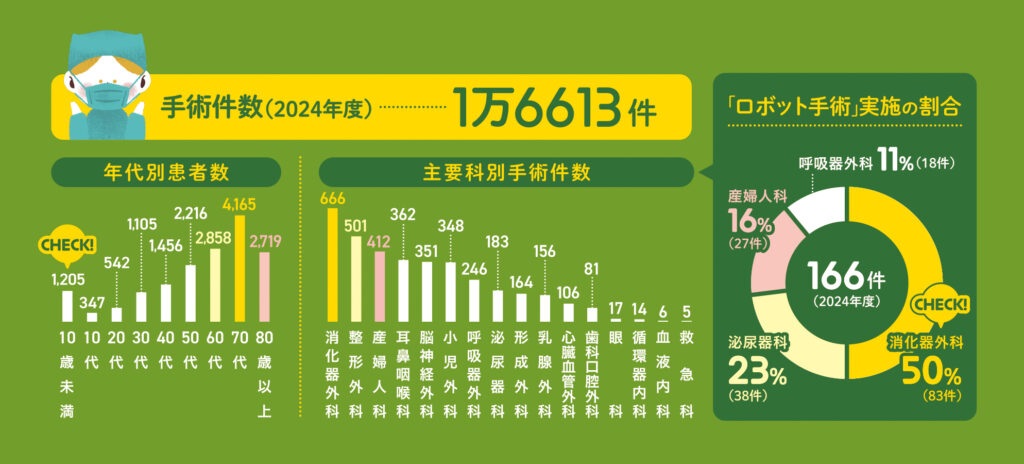
Kitano Hospital's surgical record
Kitano Hospital, which performs many surgeries every year, is characterized by a large number of surgeries on young children, and a high proportion of "robot-assisted surgery" performed in the gastrointestinal surgery department.