Medical Research Institute KITANO HOSPITAL, PIIF Tazuke-Kofukai
Inquiry
search
close


what's new

A research team at the Medical Research Institute Kitano Hospital (Address: 2-4-20 Ogimachi, Kita-ku, Osaka; Chairman: Inagaki Nobuya), a public interest incorporated foundation, has demonstrated through a multi-center randomized controlled trial that local cooling with ice water, which is used to treat sports injuries, is an effective, simple, and safe method of preventing post-ERCP pancreatitis (PEP) that occurs after ERCP (endoscopic retrograde cholangiopancreatography), suggesting the possibility of it becoming a new standard of care.
The results of this research will be published in a global gastroenterology journal on July 10, 2025.Published in The American Journal of GastroenterologyIt was done.
Citation: Azuma et al. Am J Gastroenterol. 2025. Doi: 10.14309/ajg.0000000000003644
ERCP is an important endoscopic procedure used to treat various biliary and pancreatic diseases, including bile duct stone removal and biliary drainage. However, postoperative PEP is a problematic complication. The incidence of PEP is reported to be approximately 5-10%, and since it can be life-threatening if severe, prevention is an important issue.
International guidelines strongly recommend the use of rectal administration of nonsteroidal anti-inflammatory drugs (NSAIDs) for the prevention of PEP, but in Japan, they are not widely used for PEP prevention due to safety concerns regarding dosage and not being covered by health insurance.
Given this situation, the development of a new PEP prevention method that is safe and simple and can replace or be used in addition to existing prevention methods has become an urgent issue in Japan.
The research team therefore focused on the fact that ice therapy, which is widely used in sports medicine and other fields, is effective in promoting local vasoconstriction and reducing metabolic activity, thereby reducing edema, etc. Based on the hypothesis that papillary edema after ERCP is one of the causes of PEP, they hypothesized that cooling the duodenal papilla with ice water might suppress edema and reduce the occurrence of PEP.
This study was a multicenter, single-blind, parallel-group, randomized controlled trial [references: 464, 502, 527]. Eight Japanese hospitals participated, and 880 adult patients with an indication for ERCP were enrolled between March 2022 and February 2024.
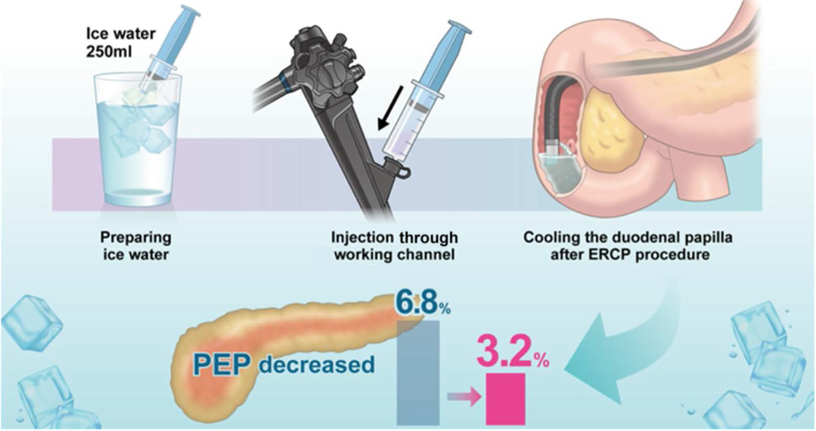
Patients were randomly assigned in a 1:1 ratio to either a group in which the duodenal papilla was cooled with ice water after ERCP (ice water cooling group) or a control group in which no cooling was performed. Ice water cooling was performed by injecting 250 mL of ice water into the papilla using a syringe in five 50 mL increments after the ERCP procedure. The incidence of PEP, the primary endpoint, was as follows:
The ice-water cooling group showed a significantly lower incidence of PEP compared with the control group (P = 0.02), with an absolute risk reduction of 3.61 TP3T and a relative risk reduction of 52.41 TP3T.
Secondary endpoints included cholangitis, bleeding, perforation, and mortality, but no significant differences were observed between the two groups. In particular, no adverse events directly related to ice water cooling were reported.
Furthermore, subgroup analysis suggested that ice water cooling further significantly reduced the incidence of PEP in high-risk patients (those with high-risk factors for PEP) and patients who underwent endoscopic sphincterotomy (ES). However, no preventive effect of ice water cooling was observed in patients who underwent prophylactic pancreatic duct stent placement. This suggests that the edema-suppressing effect of cooling may not be duplicated, as the pancreatic duct stent reduces obstruction to pancreatic juice drainage due to ampullary edema.
This study is the first in the world to demonstrate the effectiveness and safety of ice water cooling to prevent PEP, and its results are groundbreaking for the Japanese medical community. This simple, low-cost method does not require special skills or equipment and can be easily implemented by any physician who performs ERCP.
However, this study also has several limitations. Because the control group did not receive sham cooling (e.g., room-temperature water injection), it was not possible to clearly distinguish whether the effects were due to the cooling effect itself or simply the cleansing effect. Furthermore, there is a lack of scientific evidence regarding the amount of ice water (250 mL) and cooling time, and optimal protocols must be established in future studies. Furthermore, NSAIDs were not used in this study for ethical reasons, so the combined effects of ice water cooling and NSAIDs require further investigation.
Future studies are expected to include a control group using room temperature water, optimization of the amount and duration of ice water use, and verification of its combined effect with NSAIDs. Through these studies, it is hoped that ice water cooling will be established as a standard treatment for preventing PEP, enabling more patients to undergo ERCP safely.
For media inquiries regarding this matter, please contact:This email formPlease note that we do not answer questions from the general public.


